
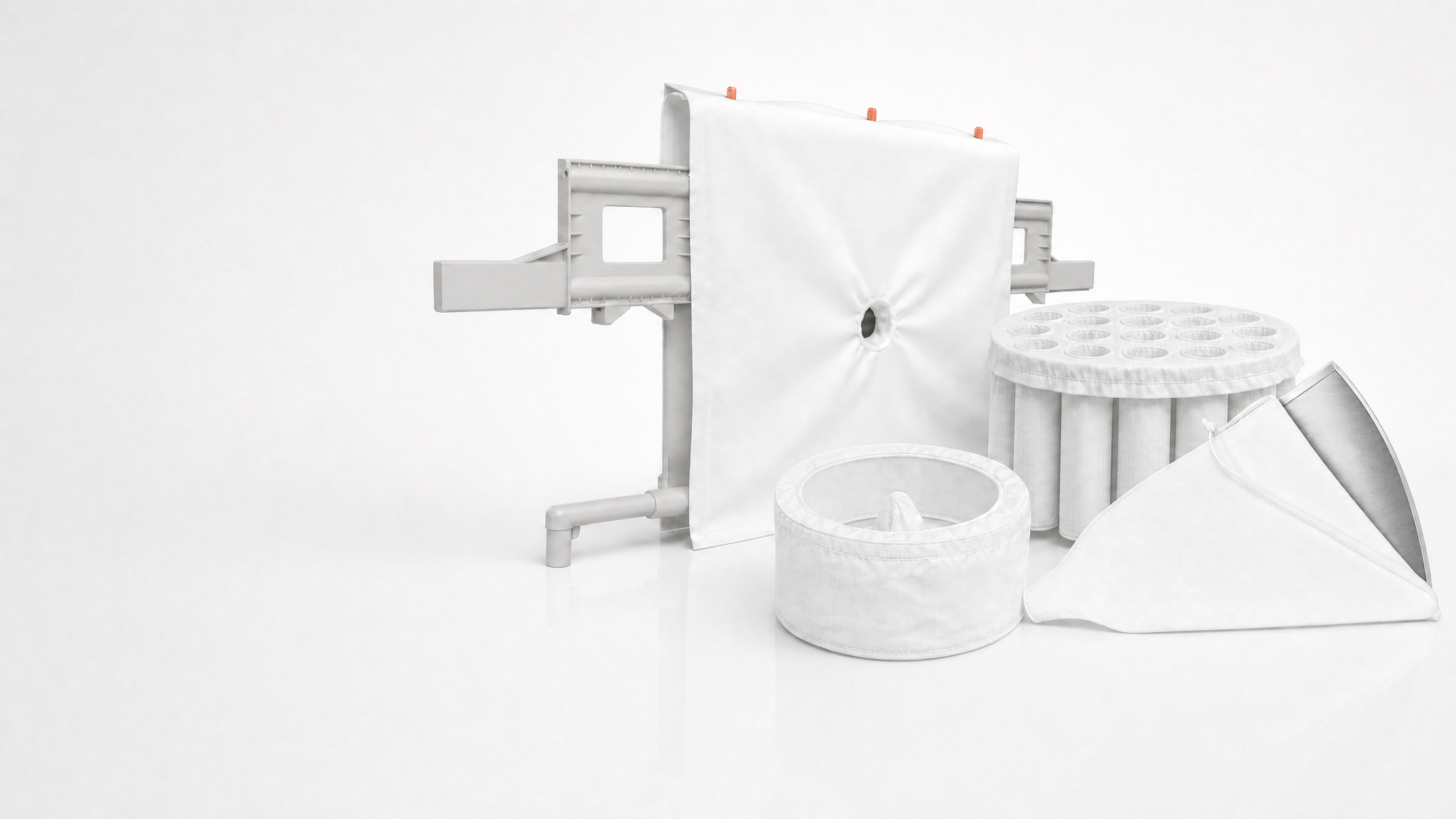
PEEK filter fabric is expensive. Compared with polypropylene the price per square metre is in a different league, and any honest supplier will tell you that in most applications it makes no economic sense at all. The interesting question is not whether PEEK is expensive – it is, and it will stay that way – but under which conditions the square-metre price stops being the number that matters.
The comparison that actually decides it
The wrong calculation is fabric cost per set. The right calculation is cost per operating hour, including everything a change-out drags with it: the elements themselves, the labour to fit them, the production lost while the machine is open, and – in the worst cases – the batch that had to be scrapped because a cloth failed mid-cycle.
In a plant where a change-out is a planned two-hour job during a scheduled stop, a cheap fabric changed often is usually the better business. In a plant where opening the filter means a day of lost production, or where the failure is unpredictable, the arithmetic inverts quickly. At that point a fabric that costs several times more per square metre but runs three or four times longer, and runs predictably, is simply cheaper.
Where PEEK genuinely earns its place
- Above the range of PPS and aramid: as an orientation figure PEEK is usable to around 260 °C continuous, against roughly 190 °C for PPS and 200 °C for aramid. Where the process genuinely sits above the cheaper polymers, there is no clever workaround.
- Heat plus aggressive chemistry: PEEK carries a very broad pH tolerance alongside the temperature capability. Aramid does not – it is limited to a much narrower pH band – so combined thermal and chemical load is exactly where aramid drops out and PEEK stays in.
- Heat plus mechanical load: where the element is under real tension, flexing or abrasion at temperature, PEEK's retained mechanical strength is the reason to choose it over PTFE, which is chemically superb but mechanically much softer.
- Unpredictable failure is unaffordable: where a mid-cycle cloth failure means a scrapped batch or a contaminated downstream process, the value of predictability outweighs the material cost on its own.
Where it does not
If PPS or PTFE covers your duty, use PPS or PTFE. If a polyester fabric is failing and the cause turns out to be hydrolysis in a hot wash rather than the process temperature, the answer may be a different mid-range polymer and a changed cleaning procedure – not the most expensive fabric on the shelf. And if the seams keep failing while the fabric is still sound, no polymer upgrade will help until the sewing thread and the confection are corrected.
We would rather sell you PPS that works than PEEK that was not necessary. Recommending the expensive option where the cheap one suffices is a short-term business.
The fabric is only part of the cost case
A PEEK cloth sewn with a standard polyester thread will fail at the seam long before the fabric is anywhere near its limit – and the whole investment is wasted. The same applies to eyelets, rings and clamping strips in an unsuitable stainless grade, and to a fabric that was never thermally set for the temperature it now sees. If you are paying for a high-performance polymer, the confection has to be specified to the same class.
How to test the case for your plant
Take your current fabric cost per set, divide by the actual service life in operating hours, and add the fully loaded cost of each change-out including lost production. Then do the same calculation with an assumed service life for the higher-class fabric. If the second number is lower, the material price was never the deciding factor. If it is not lower, stay where you are – and let us look at whether the construction, the seam or the cleaning cycle can be improved instead.
Background on the polymers and the failure mechanisms on our high-temperature filtration page, material data on the specialty fabrics page, and a polymer comparison for spin-dryer duties in our post on PEEK vs. PP vs. PET for centrifuge filter media. Yes – we can supply PEEK and PPS fabrics and finished elements. Tell us the duty and we will tell you honestly whether you need them.