
Application
High-Temperature Filtration — Filter Fabrics for Hot Process Liquids
When the process runs hot, the filter fabric decides how long the plant runs. We engineer fabrics and confection for hot solid–liquid separation — from the upper limits of polypropylene and polyester to PPS, PEEK, PTFE and aramid.
Why Hot Duties Break Filter Fabrics
Most filter fabric selection starts with fineness and permeability. In a hot process that order is wrong. Temperature changes the polymer itself: it softens, creeps under load, loses dimensional stability and — in the presence of water — can be chemically attacked from the inside out.
The failure pattern is characteristic. A cloth that has gone soft stretches, no longer seals at the edge and lets fines through. A hydrolysed cloth still looks intact but tears at the seam under normal handling. A cloth at its creep limit deforms permanently around the drainage support and never recovers its original fit.
None of this is visible on a datasheet that lists a single maximum temperature. What matters is the combination: how hot, wet or dry, at what pH, under what mechanical load, and for how long per cycle.
Typical Symptoms in Hot Service
Dry Heat and Wet Heat Are Two Different Problems
This distinction is the single most common source of wrong material selection in hot filtration — and it is almost never stated on a specification sheet.
Dry Heat
Hot gas, hot air drying, a heated dryer bag or a hot but essentially water-free liquid. The load is primarily thermal and mechanical.
- The polymer softens and creeps; dimensional stability is the limiting property.
- Datasheet continuous-service temperatures are a usable first orientation here.
- Polyester and aramid perform well; PPS and PEEK extend the range further.
- Thermal setting of the fabric matters, otherwise the cloth shrinks in service.
Wet Heat and Hydrolysis
Hot filtrate, condensate, steam cleaning or hot caustic wash. Water is present, and now a chemical degradation mechanism runs alongside the thermal one.
- Polyester is attacked by hydrolysis; in hot alkaline wet conditions its usable limit drops well below the dry figure.
- Strength is lost internally — the cloth can look perfect and still tear.
- Polypropylene is hydrolysis-stable but limited to roughly 90 °C.
- Above that, in wet heat, PPS, PEEK and PTFE are the realistic candidates.
The practical rule: a steam or hot-caustic cleaning cycle counts as part of the duty. Many fabrics are not destroyed by the process but by the cleaning regime — the fabric has to be specified for the hottest, wettest, most aggressive minute of the whole cycle, not for the average.
Where Each Polymer Runs Out
Orientation values for continuous service in dry or neutral conditions. Read them as a starting point for a conversation, not as a guarantee: in wet heat, aggressive chemistry or under high mechanical load the usable limit is lower, sometimes considerably.
| Polymer | Continuous (orientation) | pH | Behaviour in wet heat | Where it fits |
|---|---|---|---|---|
| Polypropylene (PP) | ≈ 90 °C (peaks to 100 °C) | 1–14 | Hydrolysis-stable, low moisture uptake | The chemical workhorse — but the first to run out of temperature. |
| Polyamide (PA6 / PA66) | 120 / 130 °C | > 3 | Absorbs water, swells | Very abrasion-resistant; not for strong mineral acids. |
| Polyester (PET) | 150 °C dry | 2–10 | Hydrolysis risk in wet heat above ≈ 80 °C | Strong and cheap — the classic wrong choice for hot caustic. |
| PVDF | 150 °C | 1–14 | Stable | Best oxidation resistance; halogens, oxidising acids. |
| PPS | 190 °C | 1–14 | Stable, dimensionally stable when hot | The pragmatic high-temperature choice; inherently flame retardant. |
| Aramid | 200 °C | 4–11 | Limited in strong acids and alkalis | Heat plus outstanding mechanical strength. |
| PEEK | 260 °C | 1–14 | Stable, steam-sterilisable | Highest combined thermal, chemical and mechanical performance. |
| PTFE | 260 °C | 0–14 | Stable | Virtually inert, non-stick — outstanding cake release. |
Nomex® and Kevlar® are registered trademarks of their respective owners. R+F FilterElements is an independent manufacturer of filter fabrics and filter elements.
Hot Solid–Liquid Separation Duties We Work On
High-temperature filtration is rarely a large-volume business — it is a collection of specific, technically demanding duties. These are the ones we see most often.
Hot Wax & Paraffin
Filtration above the congealing point, where the cake must stay releasable and the cloth must survive both the hot filtrate and the cleaning cycle.
Hot Lube & Base Oils
Dewaxing, clay treatment and polishing filtration in oil processing, where viscosity is only manageable while the oil is hot.
Polymer Melt & Additive Filtration
Very high temperatures with mechanical load from pressure — the domain of PEEK, PPS and metal-supported constructions.
Molten Sulphur
Filtered as a hot liquid in a narrow temperature window, with the fabric having to tolerate sulphur chemistry and solidification on shutdown.
Hot Caustic & Acid Process Liquids
Bayer-type liquor, pickling and regeneration circuits, where temperature multiplies chemical attack instead of merely adding to it.
Sugar & Starch Hot Filtration
Hot juice, syrup and hydrolysate filtration, where wet heat and pH make polyester a risky default.
Battery Material & Precursor Filtration
Hot precipitation and washing steps in cathode precursor production, with tight purity requirements and aggressive chemistry.
Hot Gypsum & Phosphoric Acid
Phosphogypsum and process acid filtration at elevated temperature — a combined thermal, chemical and abrasive load.
The Fabric Is Only Half the Solution
High-temperature filter elements most often fail at the details around the cloth. Every component that goes into the element has to hold the same temperature and the same chemistry.
Sewing Thread
A PEEK or PPS cloth stitched with standard polyester thread fails at the seam first. The thread has to match the fabric — PTFE, PPS, PEEK or aramid, depending on the duty.
Welded vs. Stitched
Where the polymer allows it, a welded joint removes the thread as a weak point and the needle holes as a contamination path. Not every high-temperature polymer can be welded — we say which.
Metal Parts
Eyelets, rings, clamps and springs in a stainless steel grade matched to the medium — a hot chloride-bearing liquid will find an unsuitable grade quickly.
Thermal Setting & Shrinkage
A fabric that has not been set for its service temperature shrinks in the first hot cycles. Dimensioning has to allow for the real thermal behaviour of the cloth.
The Honest Cost Case for PEEK
PEEK is expensive. Comparing it with a polypropylene cloth on price per square metre will always make it look absurd, and we will not pretend otherwise.
The comparison that matters is a different one: what does a change-out cost when the line has to be shut down and cooled, what does a scrapped batch cost, and how often does it happen. On a hot duty where a standard cloth survives weeks, a fabric that runs for many months usually pays for itself on downtime alone — before anyone counts the fabric.
Just as important: PEEK is not always the answer. PPS covers a large part of the hot range at a fraction of the cost, and PTFE is often the better choice when cake release or chemical inertness is the real problem rather than temperature. Where a cheaper polymer will do the job, that is what we recommend.
What We Need to Specify a Hot Duty
Related Topics
Materials, machines and elements that belong to hot solid–liquid separation.
Specialty Fabrics — PEEK, PPS, PVDF, PTFE, Aramid
The high-performance polymers, side by side with temperature and pH data.
Learn MoreHot Oil & Polymer Melt Filtration
Viscous hot media, high pressure and the fabrics that survive them.
Learn MoreMolten Sulphur Filtration
A narrow temperature window, aggressive chemistry and solidification risk.
Learn MoreWax Filtration
Hot filtration where cake release decides the economics.
Learn MoreChemical Industry
Combined chemical and thermal load in process filtration.
Learn MoreFabrication & Confection
Seams, welding, hardware and cut parts for high-temperature elements.
Learn MoreFrequently Asked Questions
Up to what temperature can a woven filter fabric be used?
It depends entirely on the polymer and on whether the heat is dry or wet. As continuous service guidance we work with roughly 90 °C for polypropylene, 120–130 °C for polyamide, 150 °C for polyester, 150 °C for PVDF, 190 °C for PPS, 200 °C for aramid and 260 °C for PEEK and PTFE. These are orientation values for dry or neutral conditions. In hot water, steam or hot alkaline liquid the usable limit can be far lower, which is why we never quote a single figure before the real process conditions are known.
Why does polyester fail in hot water even though it is rated to 150 °C?
Because the 150 °C figure describes dry heat. Polyester is susceptible to hydrolysis: in the presence of water, and especially in hot alkaline conditions, the polymer chains are attacked and the fabric loses tensile strength from the inside out. The cloth can look intact and still tear at the seam. In wet heat above roughly 80 °C we therefore consider polypropylene, PPS, PEEK or PTFE instead, depending on the chemistry.
What is the difference between dry heat and wet heat for filter fabrics?
Dry heat mainly loads the polymer thermally: it softens, creeps under load and loses dimensional stability. Wet heat adds a chemical mechanism — hydrolysis — and often carries dissolved acids or alkalis, whose aggressiveness rises sharply with temperature. A fabric that is perfectly stable in a 140 °C dryer can be destroyed within weeks in 100 °C caustic filtrate. Temperature alone is never a sufficient specification.
Is PEEK worth the cost for filter fabrics?
PEEK is one of the most expensive filter polymers, so it is never justified by a datasheet comparison. It is justified when the alternative is repeated unplanned downtime, scrapped product batches or frequent cloth changes on a hot line. If a standard cloth lasts a few weeks and a PEEK cloth runs for many months on the same duty, the fabric price becomes a minor item next to the cost of stopping the plant. Where PPS or PTFE can do the job, we say so.
Do seams and hardware also have to be temperature-resistant?
Yes, and this is where high-temperature solutions most often fail. A PEEK or PPS fabric sewn with standard polyester thread will fail at the seam long before the fabric does. Thread material, welded instead of stitched joints where the polymer allows it, and metal parts such as eyelets, rings and clamps in a suitable stainless steel all have to match the service temperature and the chemistry. We specify the complete confection, not just the cloth.
Can you supply PEEK and PPS filter fabrics?
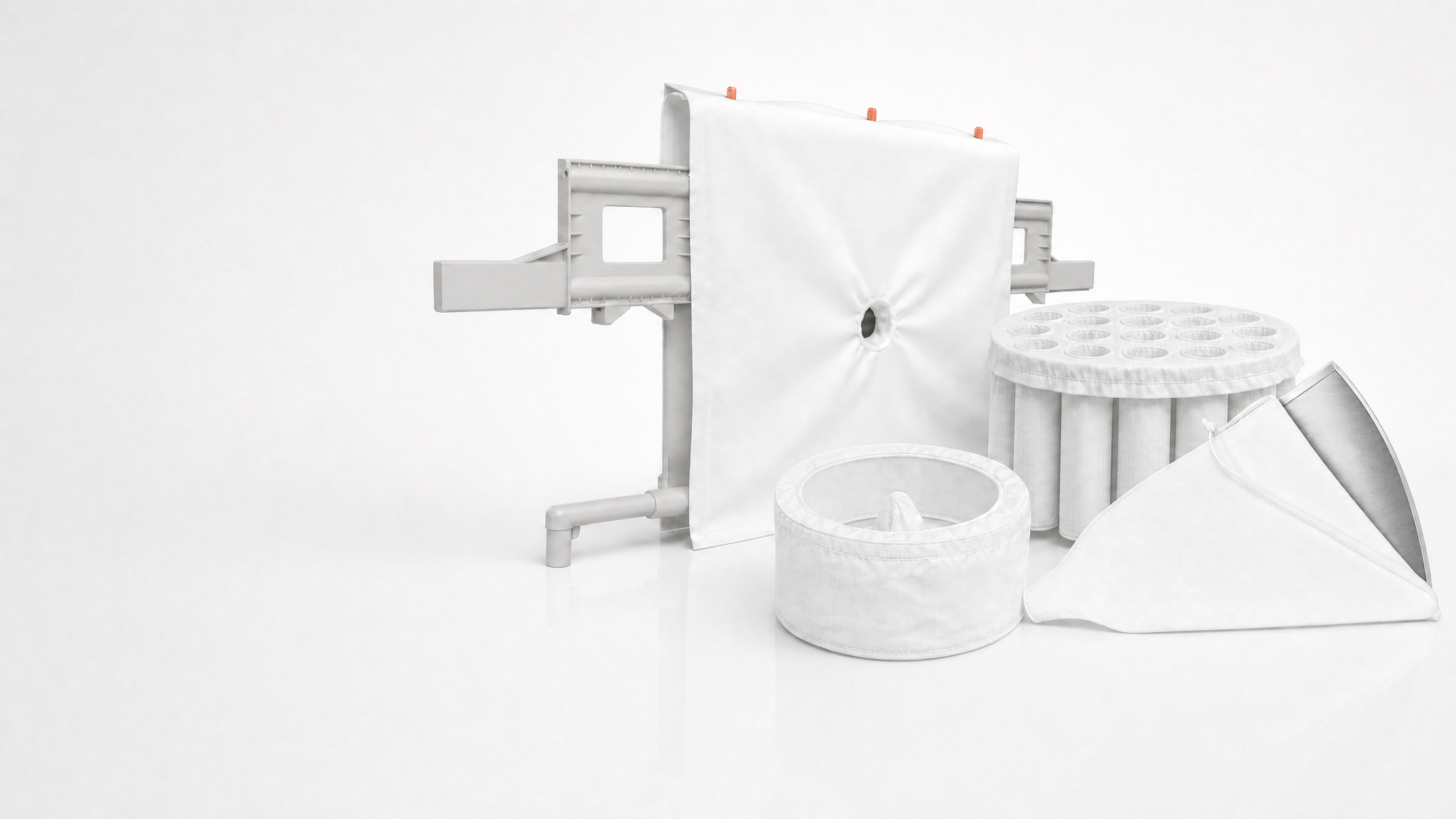
Yes. PEEK, PPS, PVDF, PTFE and aramid fabrics are part of our programme, available as roll goods by the metre or fabricated to your machine — filter press cloths, centrifuge bags, nutsche filter bags, disc filter cloths, sleeves and cut parts. Samples can be supplied for evaluation before you commit to a full set.
Running a hot duty that eats filter cloths?
Tell us the temperature, whether the heat is wet or dry, the chemistry and your current fabric — we will propose a polymer, a construction and a confection that holds.
Send Inquiry