
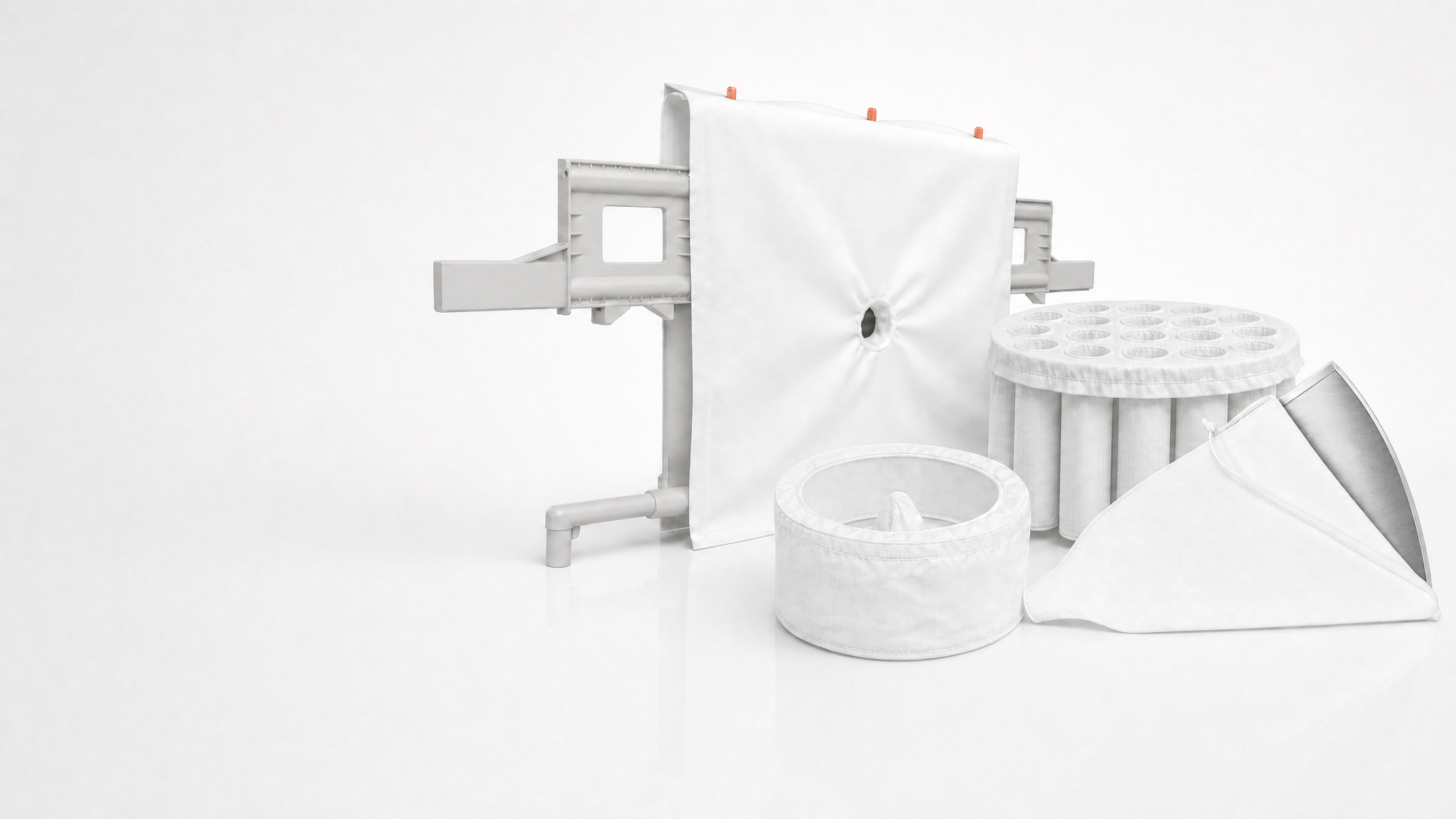
Rotary disc vacuum filters work best when the cloth matches the sector geometry, the slurry chemistry, and the discharge behavior you need on shift. If the replacement cloth is wrong, you will usually see slower filtrate flow, poor cake release, or leakage at the fastening points long before the next planned shutdown.
This guide shows how to select and replace rotary disc filter cloths with a focus on practical operator decisions: fit, fastening, material choice, and common failure modes. If you are also comparing cloths for other separation equipment, see our RF-PLF Series pressure leaf filter fabrics and RF-CF Series centrifuge fabrics.
🔑 Key Takeaways
- Match the cloth to the disc sector layout, not only the filter model name.
- Choose fastening details that prevent drip leakage and edge wear.
- Select the fabric material based on abrasion, chemistry, temperature, and cake release.
- Use a repeatable replacement check to avoid downtime and uneven filtration.
⚙️ What Makes Rotary Disc Filter Cloths Different?
On a rotary disc vacuum filter, the cloth is not just a cover; it is the active filtration surface that determines how quickly the sector builds cake and how cleanly it discharges. The cloth has to wrap around the sector correctly, maintain tension during rotation, and seal reliably at seams, lacing, or clamping points.
For operators, the main challenge is that disc filters often run with changing feed solids, variable vacuum, and aggressive wash cycles. That means a cloth that looks acceptable on day one can still fail early if its weave, seam construction, or cut pattern is not aligned with the process.
Sector geometry: the first thing to verify
Before ordering a replacement, confirm the sector dimensions and the disc layout. Even small differences in arc length, radial depth, or edge overlap can create wrinkles, bypass, or premature wear on the leading edge.
📋 Pre-order geometry check
- Disc diameter and number of sectors
- Sector width, arc length, and depth
- Center hub cut-out and edge allowances
- Fastening style at the perimeter and center
- Rotation direction and discharge position
If you are unsure about the exact construction, compare the setup with our rotary disc filter machine overview and then use the configure your rotary disc filter filter fabric online tool to generate a pre-filled, non-binding specification and inquiry.
🔬 How to Select the Right Cloth Material
The best material is the one that survives your slurry and still releases cake reliably. In practice, that means balancing filtration efficiency against abrasion resistance and chemical compatibility.
| Operating need | Typical fabric choice | Operator benefit |
|---|---|---|
| Fine solids, stable cake | Monofilament or smooth-surface fabric | Better surface release and easier cleaning |
| Abrasive slurry | Robust woven construction | Longer wear life on the disc edge |
| Corrosive media | Chemically resistant polymer selection | Reduced swelling and fiber damage |
| Higher temperature service | Temperature-rated material | Stable fit and less deformation |
🛠️ Fastening and Sealing: Where Most Replacement Problems Start
Many cloth failures are not caused by the fabric itself, but by poor fastening. A cloth that is slightly loose, twisted, or unevenly clamped can create bypass, drip leakage, or fabric flutter during rotation.
💡 Tip: When replacing a disc cloth, inspect the fastening hardware first. Worn clips, stretched lacing, or damaged sealing strips can make a new cloth perform like a used one.
⚠️ Caution: Never force a cloth into position by over-tensioning it. Excess tension can distort the sector shape, damage seams, and reduce drainage performance during the first production cycle.
For plants dealing with recurring edge leakage, it is worth reviewing the root cause on the drip leakage page. If cloth blinding is your bigger issue, the guidance on filter cloth clogging can help you identify whether the problem is mechanical, chemical, or process-related.
Check where wear started: seam line, leading edge, center cut-out, or discharge zone.
Remove fines, scale, and residue so the new cloth sits flat and seals properly.
Align the weave and fastening points before tightening to avoid wrinkles and localized stress.
Verify clearance, overlap, and sealing before returning the filter to slurry service.
📊 Replacement Decision Guide for Operators
If you are deciding whether to replace one cloth, a full disc set, or only a damaged sector, look at the wear pattern. Uneven wear often means a process issue, while uniform aging usually points to normal end-of-life.
Rule of thumb: Replace the cloth when cleaning no longer restores flow, the seam begins to leak, or cake release becomes inconsistent across multiple cycles.
📋 Replacement readiness checklist
- Visible thinning, fraying, or seam damage
- Drop in filtrate rate at the same vacuum setting
- More carryover or wetter cake after discharge
- Persistent leakage after cleaning and re-tensioning
- Signs of chemical attack or heat distortion
For applications with difficult solids, also review the process context on mining applications or chemical industry applications. That helps narrow down whether you need a more abrasion-resistant cloth or a material with better chemical stability.
✅ Choosing the Right R+F Product Family
For rotary disc vacuum filters, the dedicated choice is our RF-RD Series disc filter fabrics. They are designed to match the geometry, fastening method, and operating demands of disc filter installations, so you get a more reliable fit and fewer surprises during commissioning.
If your site also runs vacuum filtration on other machines, you can compare the construction logic with our RF-BF Series belt filter fabrics or use the vacuum filter machine overview as a reference point for shared operating issues like cloth blinding and vacuum stability.
💡 Tip: Keep one reference sample of the installed cloth, plus a photo of the sector geometry and fastening detail. That makes reordering much faster after maintenance shutdowns.
For ATEX-sensitive areas or dust-exposed surroundings, check whether your installation requires special precautions and review the antistatic and ATEX guidance before choosing the final fabric specification.
📩 Need Help Choosing the Right Fabric?
Our technical team at R+F FilterElements can help you find the perfect filter fabric for your specific application. Get in touch for a free consultation — we will recommend the right solution based on your machine, process, and operating conditions.
Prefer to start online? You can configure your rotary disc filter filter fabric online and receive a pre-filled, non-binding specification and inquiry in just a few steps.