
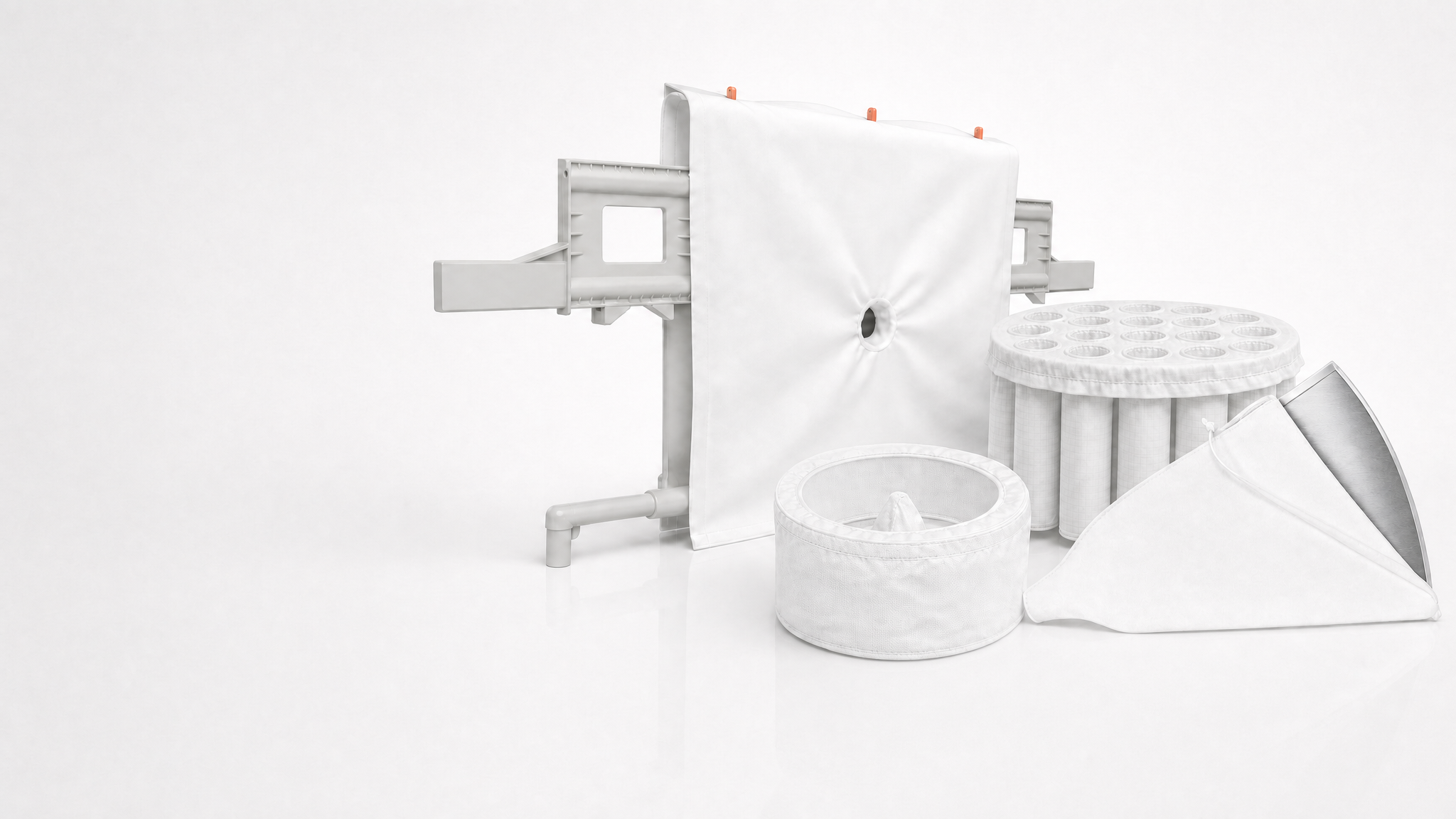
In pharmaceutical water systems, the final membrane stage gets most of the attention—but as an operator, you know the plant depends just as much on stable pre-treatment. Before WFI or purified water reaches ultrafiltration, RO, or polishing steps, filter fabrics help protect beds, trap fines, and keep utility filtration consistent under GMP conditions.
🔑 Key Takeaways
- Pre-treatment fabrics protect multimedia filters, carbon beds, and ion exchange systems from particle carryover.
- For pharma utilities, extractable-free, low-shedding, and consistently retained fabrics are essential.
- Validated cleaning and predictable performance support GMP-compliant water generation and utilities.
- R+F custom filter elements can be specified for pharma pre-treatment equipment and utility filtration loops.
💡 Tip: In pharma water treatment, pre-treatment failure often shows up later as higher differential pressure, shorter membrane life, or unstable conductivity. Start upstream.
🏭 Why Pre-Treatment Matters in WFI and Purified Water Systems
WFI and purified water trains usually rely on membrane systems at the final stage, but those membranes only perform well if the upstream solids load is controlled. Multimedia filters, activated carbon vessels, and ion exchange units all need reliable support filtration to prevent media loss, keep turbidity low, and avoid contamination of downstream equipment.
From the operator’s side, that means the fabric is not just a “bag” or “screen.” It is a process component that influences retention, pressure drop, cleaning effort, and batch-to-batch consistency. In regulated utilities, that consistency matters as much as the water result itself.
For GMP utility systems, fabric selection should always support validated operation in the context of pharmaceutical processing applications, especially where the same water loop feeds multiple users, clean utilities, or hygiene-critical washing steps.
🔬 Where Filter Fabrics Work in the Water Train
Even in a membrane-led design, woven filter fabrics still play critical roles in the upstream stages. The main tasks are to keep solid particles out of the system and to protect the integrity of the treatment media.
Multimedia filter support
In multimedia filters, a stable support fabric helps retain graded filter media and prevents fines migration during backwash or startup. If the fabric opens too much, media escapes; if it blinds too quickly, flow becomes unstable. Operators need a balance between retention and permeability.
Activated carbon bed retention
Activated carbon beds can shed fine particles, especially after changeout, regeneration, or hydraulic disturbances. A correctly specified fabric helps retain carbon dust while preserving enough flow to avoid unnecessary pressure spikes.
Ion exchange resin trapping
Ion exchange systems are sensitive to resin leakage and resin bead carryover. A robust support or retention layer reduces the risk of bead loss into downstream equipment, pumps, and membranes. That protects both water quality and maintenance schedules.
| Pre-treatment stage | Main filtration challenge | Fabric requirement | Operator impact |
|---|---|---|---|
| Multimedia filter | Media retention and backwash stability | Dimensional stability, controlled porosity | Lower media loss, consistent flow |
| Activated carbon bed | Carbon fines carryover | Fine retention with low shedding | Cleaner downstream equipment |
| Ion exchange unit | Resin bead leakage | Reliable bead trapping, chemical resistance | Protected membranes and pumps |
🧪 Fabric Requirements for Pharma Utility Systems
For water systems serving GMP production, the fabric itself becomes part of the contamination control strategy. That means the material and manufacturing route must be selected with the same discipline as the process equipment.
- Extractable-free or very low extractables: to reduce the risk of introducing unwanted residues into the water train.
- Validated cleaning compatibility: so the fabric can be cleaned without deformation, fiber loss, or performance drift.
- Consistent retention: to ensure the same solids capture from batch to batch and from element to element.
- Low particle shedding: essential where the water eventually feeds membranes, rinse loops, or critical utilities.
- Chemical and thermal stability: important during sanitization, flushing, and routine maintenance cycles.
⚠️ Caution: Do not assume a fabric that works in industrial water treatment is automatically suitable for pharma utilities. Residual finishes, uncontrolled fibers, or inconsistent pore behavior can create GMP risks.
🛠️ Choosing the Right Configuration for Utility Filtration
Different systems place different demands on the fabric. A support layer for a carbon bed is not the same as a retention element for a clarification step ahead of a polished water loop. If you are evaluating options for a filter press, Nutsche, or other process vessel that supports utility preparation, the geometry and sealing concept matter as much as the fabric grade.
For machines used in utility support, the right match can often be found through application-specific product families such as RF-NF Series needle felt filter elements and RF-ANF Series Nutsche pharma filter fabrics. If you are working on a broader utility system, our find and configure the right filter fabric with our Solution Finder tool lets you select your filtration machine and generate a pre-filled, non-binding specification request online.
✅ Practical Operator Checks Before Start-Up
Before bringing a pharmaceutical water train online, a few simple checks can prevent a lot of rework later. The goal is to confirm that the fabric, housing, and upstream media are clean, seated, and ready for service.
Check for correct fit, even tension, and damage at seams, edges, or clamping zones.
Confirm the element is free from dust, loose fibers, and residues from handling or storage.
Record baseline values so you can detect abnormal blinding, bypass, or media migration early.
Watch turbidity, conductivity, and particle trend data after changeout or regeneration.
📋 Pharma Pre-Treatment Checklist
- Fabric specification matches the media and vessel design
- Material is suitable for cleaning and sanitization routines
- No visible loose fibers, contamination, or packaging debris
- Upstream media is properly seated and supported
- Baseline pressure and water quality values are documented
Rule of thumb: If the pre-treatment stage is unstable, the membrane stage will spend its life compensating for upstream problems.
📊 Why Custom R+F Elements Fit Pharma Utility Systems
Pharma water systems rarely run on generic conditions. Flow, sanitization method, temperature, cleaning chemistry, and solids load can vary significantly between plants. That is why custom-built filter fabrics are often the better route than one-size-fits-all solutions.
R+F FilterElements develops custom filter elements for industrial separation duty, including utility filtration contexts where consistency and traceability matter. Whether your plant uses pressure-driven vessels, clarification stages, or side-stream protection, our designs focus on repeatable retention, low extractables, and dependable service life.
For plants using equipment similar to Nutsche filters, filter presses, or sparkler filters, the correct fabric can help reduce maintenance interruptions and improve process stability. In larger utility systems, this often translates into cleaner beds, fewer interventions, and a steadier path to compliant water quality.
If you want to review other operating scenarios, you may also find our pages on filter cloth clogging and short filter lifespan useful when diagnosing upstream issues in water pre-treatment.
📩 Need Help Choosing the Right Fabric?
Our technical team at R+F FilterElements can help you find the perfect filter fabric for your specific application. Get in touch for a free consultation — we will recommend the right solution based on your machine, process, and operating conditions.
If you are ready to start, use our Solution Finder to find and configure the right filter fabric online and receive a pre-filled, non-binding specification and inquiry.