
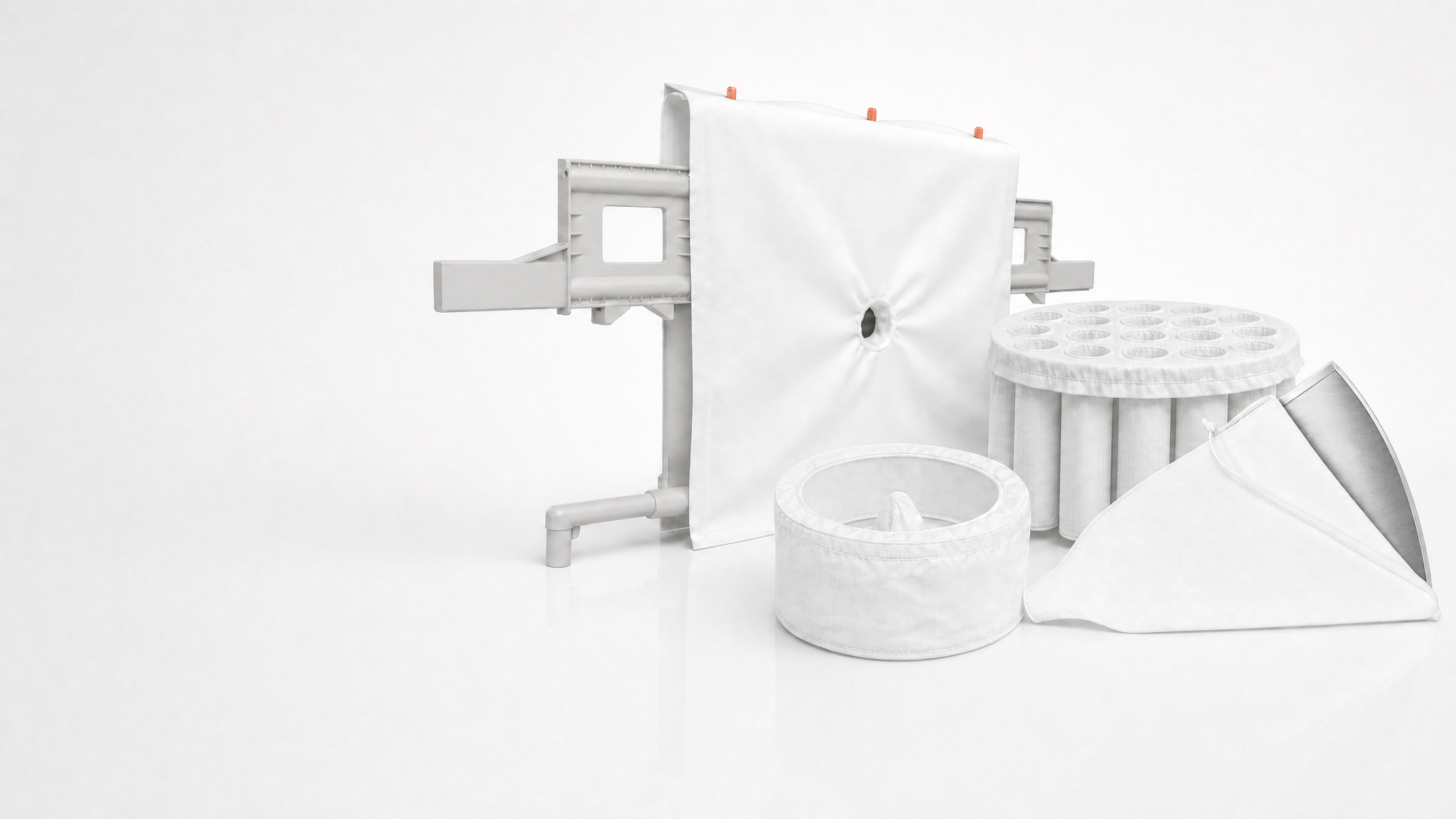
On a /machines/centrifuge, filtrate clarity is not determined by speed alone. The fabric sitting inside the basket or bowl has a direct say in whether fines pass through, stay on the cloth, or blind the surface and slow the cycle.
If you run a centrifuge in wastewater, chemical-industry, or mining service, fabric selection can be the difference between a clean filtrate and a constant rework loop. The good news: once you understand pore size, weave, and material, the right choice becomes much easier.
🔑 Key Takeaways
- Smaller pore openings usually improve clarity, but can reduce throughput and increase blinding.
- Weave structure affects how quickly solids form a stable layer and how many fines escape during start-up.
- Material choice must match chemistry, temperature, abrasion, and cleaning regime.
- Real-world tuning means checking feed solids, wet-out, tension, and edge sealing — not just spec sheets.
⚙️ Why Filtrate Clarity Starts with the Fabric
In centrifugation, the fabric is the final separation barrier before the liquid leaves the machine. If the cloth is too open, fine particles move into the filtrate; if it is too tight, you may get better clarity for a few cycles and then lose performance to blinding and slower drainage.
For many standard duties, we start with the RF-CF Series centrifuge fabrics and then adapt the pore structure and weave to the actual slurry. That is especially important when the process shifts between clean, crystalline solids and softer, compressible fines.
💡 Tip: If your filtrate is cloudy only during the first seconds of discharge, the root cause is often start-up wet-out or poor cake formation, not necessarily the wrong fabric grade.
🔬 Pore Size, Weave, and Surface Finish: What Actually Changes Clarity?
Open area versus particle retention
Pore size is the first parameter operators usually look at, but it does not act alone. In a centrifuge, the centrifugal force presses solids against the cloth and creates a filter layer; the initial fabric openings control how much fine material leaks through before that layer stabilizes.
Weave structure and filtration behavior
| Fabric structure | Clarity impact | Operational strengths | Watch-outs |
|---|---|---|---|
| Plain weave | Good retention, stable surface | Predictable, easy to understand, solid first-pass clarity | Can blind faster on sticky or very fine slurries |
| Twill weave | Balanced clarity and drainage | Smoother surface, often better release | May let more fines through if selected too open |
| Monofilament structure | Cleaner surface, less fiber shedding | Better cake release and easier washing | Needs the right pore sizing to maintain clarity |
| Multifilament structure | Can trap fine solids well | Useful where fine retention is critical | Higher risk of fouling and slower cleaning |
As an operator, I look for the point where the cloth retains enough fines to build a stable cake without becoming the main bottleneck. If the surface is too rough or the weave is too open, you often see a gray or turbid filtrate even when the centrifuge itself is running normally.
🏭 Material Choice: Matching Chemistry, Temperature, and Wear
Even a perfect weave can fail if the base material is wrong. In centrifuge service, the cloth sees mechanical stress, continuous wetting, cleaning chemicals, and often abrasive solids. If the polymer softens, swells, or wears too fast, filtrate clarity drops because the fabric loses its stable geometry.
For acidic, alkaline, or solvent-containing slurries, material compatibility is just as important as pore size. In some cases, the slurry in /applications/pharmaceutical/ or chemical-industry service demands a cleaner, more controlled construction than a standard mineral slurry.
⚠️ Caution: Do not chase clarity by over-tightening the cloth specification if the slurry is abrasive or foul-prone. A fabric that blinds quickly can produce worse overall performance than a slightly more open fabric with stable drainage. Also verify any seam, edge, or stitching detail to avoid bypass and contamination issues — see contamination from stitching.
If your process involves aggressive wash steps or solvents, review your machine setup alongside the cloth choice on centrifuge machine guidance. The fabric must survive the full operating window, not just the first day of production.
🛠️ Practical Steps to Improve Filtrate Clarity on the Floor
Measure what “clear” means in your plant: visual clarity, suspended solids, downstream filter load, or customer spec.
Compare the feed PSD against pore size and weave. If the filtrate is carrying fines, start by tightening retention before changing cycle timing.
A cloth that is poorly wetted or unevenly tensioned can let fines pass at the start of the cycle and cause inconsistent clarity.
Do not change weave, material, and wash routine all at once. Test one variable, then compare filtrate clarity and cycle time.
Rule of thumb: If clarity improves only after the cake layer builds, your fabric is probably close — but the start-up phase needs better wet-out, tension, or a slightly finer structure.
📋 Pre-Start Checklist for Better Filtrate Clarity
- Confirm feed solids size and expected particle carryover
- Inspect cloth fit, seam integrity, and edge sealing
- Check for blinding, residue, or damaged zones from the previous run
- Verify wash liquid, discharge timing, and centrifuge speed settings
- Record the first filtrate appearance before and after the cake builds
✅ Choosing the Right Fabric for Your Centrifuge Duty
Operators usually get the best result when they think in terms of balance: clarity, throughput, release, and service life. For many plants, that means starting with a purpose-built centrifuge cloth like the RF-CF Series, then testing whether a finer pore size or a different weave improves clarity without choking the machine.
If you are comparing options, keep in mind that centrifuge fabrics are optimized for the mechanical conditions of spinning separation, while other fabric families may suit different filter types. For example, a plant may use a separate media strategy on a filter press or belt filter, even when the solids come from the same upstream process.
In practice, the best fabric is the one that gives you clear filtrate, stable cycle time, and manageable cleaning effort. That is why fabric selection should always be tied to the real slurry, the actual machine, and the downstream quality requirement — not just to a catalog description.
📩 Need Help Choosing the Right Fabric?
Our technical team at R+F FilterElements can help you find the perfect filter fabric for your specific application. Get in touch for a free consultation — we will recommend the right solution based on your machine, process, and operating conditions.