
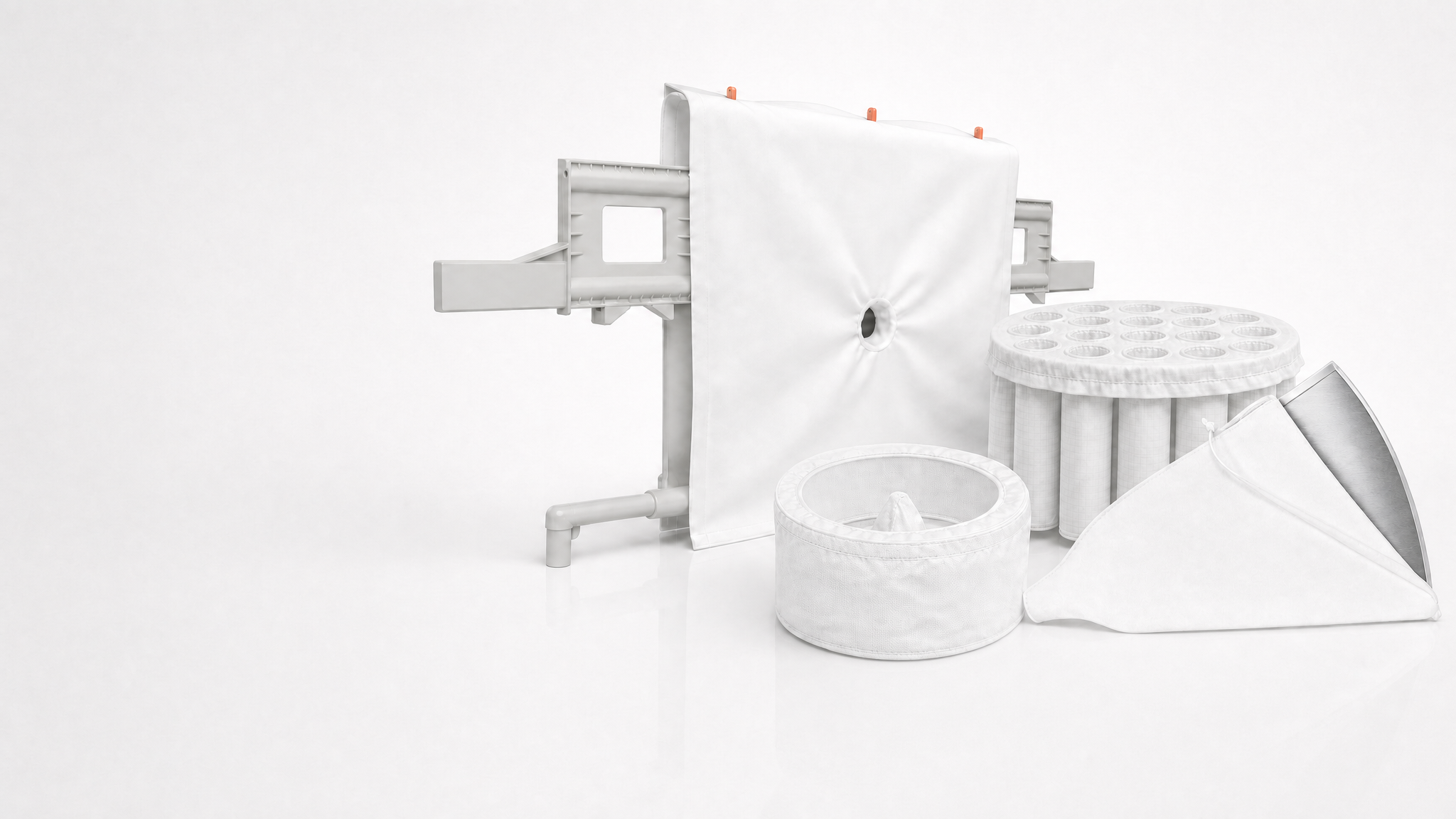
Ceramic slip and glaze production puts filter fabrics under a tough mix of abrasion, weight, and fine particle loading. Whether you run a chamber filter press for slip dewatering, polish glaze, or treat process wastewater, the fabric has to hold solids, release cake cleanly, and survive aggressive wear from silica and alumina.
🔑 Key Takeaways
- Ceramic slip filtration often runs at 30–40% solids, creating heavy cakes and high mechanical stress.
- Alumina, silica, and feldspar particles are highly abrasive, so fabric construction matters as much as pore size.
- Multifilament PP or PET with reinforced edges is a strong choice for press cloths in pottery and technical ceramics.
- Good cake release reduces downtime, improves discharge, and helps prevent cake-release problems and cloth blinding.
⚙️ Where Ceramic Filtration Starts to Fail
In ceramic production, filtration is not just about removing water. It is about controlling slip consistency, protecting downstream forming, and keeping glaze and wastewater streams stable. On the operator side, the biggest issue is usually not “can the press filter?” but “can the cloth survive repeated cycles without blinding, stretching, or tearing?”
In practice, ceramic slip may contain very fine clay minerals plus hard abrasive particles such as silica, alumina, kaolin, and feldspar. That combination creates severe wear on the cloth surface, especially at the feed zone, seams, and edges. For many plants, filter press operation is the workhorse step for dewatering and cake formation.
🔬 Slip Dewatering on Chamber Filter Presses
For ceramic slip, a chamber press is often chosen because it can handle dense slurries and build a solid press cake with high moisture removal. When the feed is around 30–40% solids, the cloth must allow fast filtrate passage early in the cycle, then support long compression phases without collapsing or leaking fines.
What the operator watches during the cycle
- Feed pressure rise: too fast can indicate blinding or poor cloth permeability.
- Filtrate clarity: fine ceramic particles should not bypass the fabric.
- Cycle time: longer fill times often point to clogging or worn cloth structure.
- Cake discharge: clay-rich cakes should release cleanly without manual scraping.
The cloth should open enough to pass water quickly while retaining the ceramic solids from the first minute.
As the press loads, the fabric must resist stretching under heavy cake weight and repeated pressure pulses.
Good release is critical for clay systems, where sticky fines can remain embedded in the weave.
💡 Tip: For ceramic slip, choose a cloth construction that balances surface smoothness for cake release with robust yarn strength for abrasion resistance.
🛠️ Material Choices for Abrasive Slip and Glaze
For this industry, we usually recommend heavy-duty multifilament PP or PET constructions. Polypropylene gives excellent chemical resistance and good release behavior, while PET can be attractive where higher temperature stability or stiffness is useful. The real difference, however, is usually in the weave design, yarn count, and reinforcement strategy.
| Fabric Attribute | Why It Matters in Ceramics | Typical Operator Benefit |
|---|---|---|
| Multifilament yarns | Better wear behavior against silica and alumina particles | Longer service life |
| Reinforced edges | Reduces tear initiation at sealing and support zones | Fewer cloth changes |
| Smooth release surface | Helps clay cake separate from the cloth | Cleaner discharge |
| Stable weave structure | Withstands heavy press cakes and repeated cycles | More consistent filtrate quality |
📊 Glaze Polishing and Wastewater Treatment
Not every ceramic filtration duty is a press cake duty. Glaze polishing often needs finer retention to remove oversize particles, agglomerates, and contamination that can ruin a surface finish. Wastewater treatment adds another layer of complexity, because ceramic sludge can fluctuate in solids content, pH, and particle hardness.
For these side streams, operators may also compare other equipment such as a belt filter or a centrifuge, depending on throughput and the nature of the solids. If your plant has multiple streams, the right fabric family may differ by machine and duty.
📋 Pre-selection checklist for ceramic filtration
- What is the average and peak solids content?
- Are the particles mainly clay, or do you also have hard minerals like quartz and alumina?
- Is cake release clean, or do you see sticking and manual cleaning?
- Does the cloth fail by wear, blinding, seam damage, or edge tearing?
- Do you need one fabric for slip, glaze, and wastewater, or separate solutions?
Rule of thumb: If the cloth looks “fine” but the press cycle keeps getting longer, the issue is often abrasion and blinding, not just mesh size.
🔧 Why the RF-FF Series Fits Ceramic Presses
For ceramic slip dewatering, the RF-FF Series filter press fabrics are designed for demanding solid-liquid separation duties where abrasion resistance and dimensional stability are critical. In heavy ceramic service, a cloth that looks acceptable on day one can fail quickly if the construction is too light or the edge reinforcement is insufficient.
The RF-FF approach focuses on abrasion-resistant constructions, robust edge finishing, and fabric geometry that supports stable cake formation. That is especially important in chamber press operation with dense slip, where cake weights are high and discharge forces can be severe.
⚠️ Caution: In ceramic service, thin or lightly finished cloths may fail early at the seam, feed zone, or edge support points. Premature tearing can contaminate product and create unplanned downtime.
If your line also uses dryer or downstream powder handling steps, keep in mind that the fabric selection logic changes with the machine. For example, RF-FBD Series fabrics for fluid bed dryers are built for a different duty than press cloths, and you should not assume one construction fits all equipment.
✅ Practical Selection Steps for Operators
To narrow the right cloth fast, start with the process reality on your floor, not just the lab sheet. The best ceramic press cloth is the one that matches the solids behavior, the press mechanics, and the expected cleaning routine.
Is the fabric failing from abrasion, blinding, chemical attack, or poor discharge?
Choose PP or PET based on temperature, chemistry, and release requirements.
Ask for strengthened edges, seam details, and fitment that suit the press model.
Compare cloth life across zones and use that data to improve the next installation.
To simplify selection, you can also find and configure the right filter fabric with our Solution Finder and receive a pre-filled, non-binding inquiry based on your filtration machine and operating conditions.
If you want to compare ceramic filtration options by machine type, also review our pages for filter presses, vacuum filters, and wastewater applications for broader process context.
📩 Need Help Choosing the Right Fabric?
Our technical team at R+F FilterElements can help you find the perfect filter fabric for your specific application. Get in touch for a free consultation — we will recommend the right solution based on your machine, process, and operating conditions.
Prefer to start online? Use the Solution Finder to find and configure the right filter fabric for your ceramic process and send a pre-filled inquiry in just a few steps.