
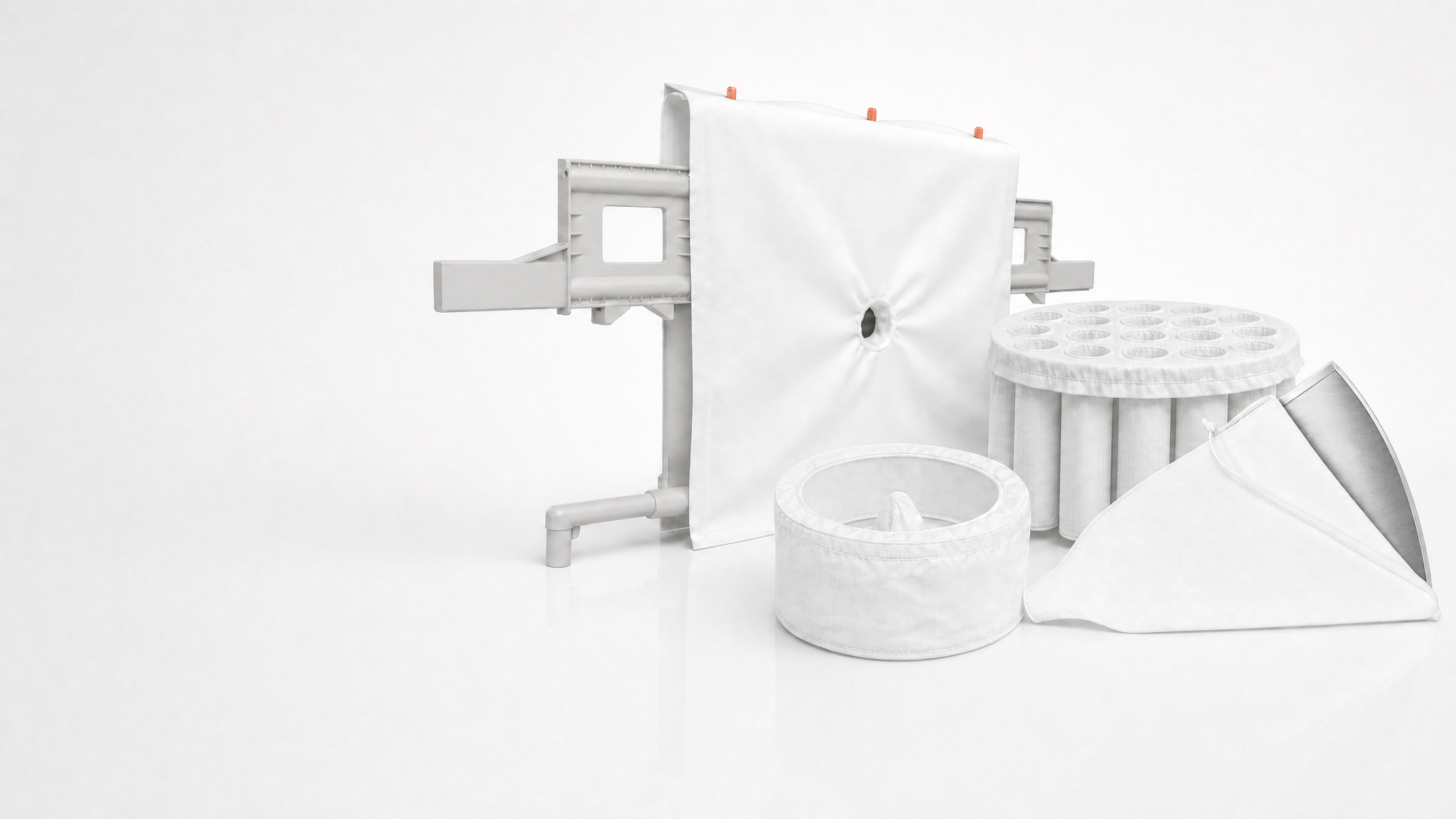
Centrifuge bag failures usually show up at the worst possible time: during a full batch, with wet solids everywhere and a machine that has to be stopped. From the operator’s side, the good news is that most failures leave a clear trail if you know what to look for — seam burst, fabric tear, heel wear, and blinding each point to a different root cause.
This guide walks through practical troubleshooting for industrial centrifuges, with a focus on how to prevent repeat failures and extend bag life in demanding applications such as chemical processing and wastewater treatment.
🔑 Key Takeaways
- Seam bursts usually come from overload, poor stitching, or sudden start/stop stress.
- Fabric tears often point to abrasion, solids impact, or handling damage during installation.
- Heel wear is driven by repeated rubbing, poor discharge geometry, or solids build-up in the basket.
- Blinding is a process issue: particle characteristics, temperature, wash cycles, and cloth selection all matter.
⚙️ What the Main Failure Modes Look Like in Operation
When a centrifuge bag fails, the pattern of damage tells you where to start. A seam burst is usually a mechanical overload problem. A fabric tear often starts with abrasion or a sharp contact point. Heel wear appears at the lower edge where solids sit, rub, and dry over time. Blinding is different: the bag may still be intact, but throughput drops and cycle times increase because liquid can no longer pass freely.
| Failure mode | Typical symptom | Most likely root cause | Best prevention |
|---|---|---|---|
| Seam burst | Bag splits at stitched line | Overfilling, weak seam construction, start/stop shock | Verify load limits, improve seam design, avoid aggressive acceleration |
| Fabric tear | Random split or cut in cloth field | Abrasion, sharp solids, poor handling | Check basket edges, reduce impact, use tougher media |
| Heel wear | Lower zone becomes thin or frayed | Solids rubbing at discharge zone | Correct discharge behavior, inspect basket geometry, adjust cycle timing |
| Blinding | Slow drainage, longer cycle time | Fine particles, sticky cake, wrong pore structure | Match fabric to particle size and washing regime |
🔬 Root Cause Analysis: Start with the Process, Not Just the Bag
If you are replacing bags often, it is easy to blame the fabric first. In practice, repeated failure is usually a process-and-fabric mismatch. The same centrifuge bag can work well in one product line and fail quickly in another because of different particle size, cake hardness, temperature, or chemical exposure.
What to check during the first inspection
- Load pattern: Is the basket being overfilled or unevenly charged?
- Start-up behavior: Are acceleration and deceleration too aggressive?
- Solids properties: Are crystals sharp, abrasive, sticky, or fine enough to blind the fabric?
- Wear points: Are seams rubbing against the basket, covers, or discharge hardware?
- Cleaning routine: Is residual cake building up in the heel zone after each cycle?
💡 Tip: If the failure always appears in the same spot, inspect the centrifuge basket, support ring, and discharge path before ordering another bag. The machine often creates the damage pattern.
🛠️ Prevention Measures That Actually Work
The best prevention strategy combines fabric selection, machine condition, and operating discipline. For demanding installations, choose a media construction that fits the chemistry and mechanical stress. For example, the RF-CF Series centrifuge fabrics are designed for this type of rotating separation duty, while the RF-NF Series needle felt media can be useful when process conditions call for a different balance of retention and drainage.
Check basket edges, seams contact points, discharge geometry, and any signs of imbalance or vibration.
Select pore structure, weight, and finish based on particle size, cake release behavior, and chemical resistance.
Avoid sudden speed changes, overloading, and incomplete discharge that leaves abrasive heel build-up behind.
Handle bags carefully during installation, and document life trends so failures can be corrected early.
⚠️ Caution: Do not keep running a centrifuge with a torn bag, even for “one more shift.” Escaping solids can damage the machine, contaminate product, and create a serious safety risk.
📋 Fast Troubleshooting Checklist for Operators
📋 Pre-Changeout and Failure Review Checklist
- Document where the damage started: seam, field, heel, or full-blinding pattern
- Check whether failures happen after a specific batch size or cycle count
- Look for sharp basket edges, worn support parts, or misalignment
- Review whether the cake is too wet, too sticky, or too abrasive for the current fabric
- Confirm that cleaning, wash cycles, and drying steps are actually removing residual solids
Rule of thumb: If bag life drops suddenly, suspect a process change first — new feed solids, a different wash program, or a machine issue — before assuming the fabric itself has changed.
📊 How Short Bag Life Connects to Other Problems
Repeated bag damage is often part of a wider wear pattern. If you are also seeing higher pressure drop, slower drainage, or more frequent changeouts, it is worth reviewing our troubleshooting note on short filter lifespan. In many plants, the visible failure is only the last stage of a problem that began with poor media selection or unstable operation.
Blinding, for example, can shorten bag life indirectly by increasing vibration, stressing seams, and forcing operators into harsher cleaning routines. Likewise, heel wear can lead to tear initiation at the lower edge, which then turns into a full fabric failure on the next cycle.
✅ Practical Takeaway for Stable Centrifuge Runs
For operators, the goal is not just to replace bags faster — it is to eliminate the cause of repeat failures. The most reliable centrifuge installations combine correct fabric specification, smooth machine mechanics, and consistent operating discipline. When those three are aligned, bag life improves, downtime drops, and the process becomes far easier to control.
If you are troubleshooting a specific machine, it can help to review the centrifuge setup alongside related media options for other separation systems, such as RF-FF Series filter press fabrics or centrifuge machine guidance, especially when comparing wear patterns across sites.
📩 Need Help Choosing the Right Fabric?
Our technical team at R+F FilterElements can help you find the perfect filter fabric for your specific application. Get in touch for a free consultation — we will recommend the right solution based on your machine, process, and operating conditions.