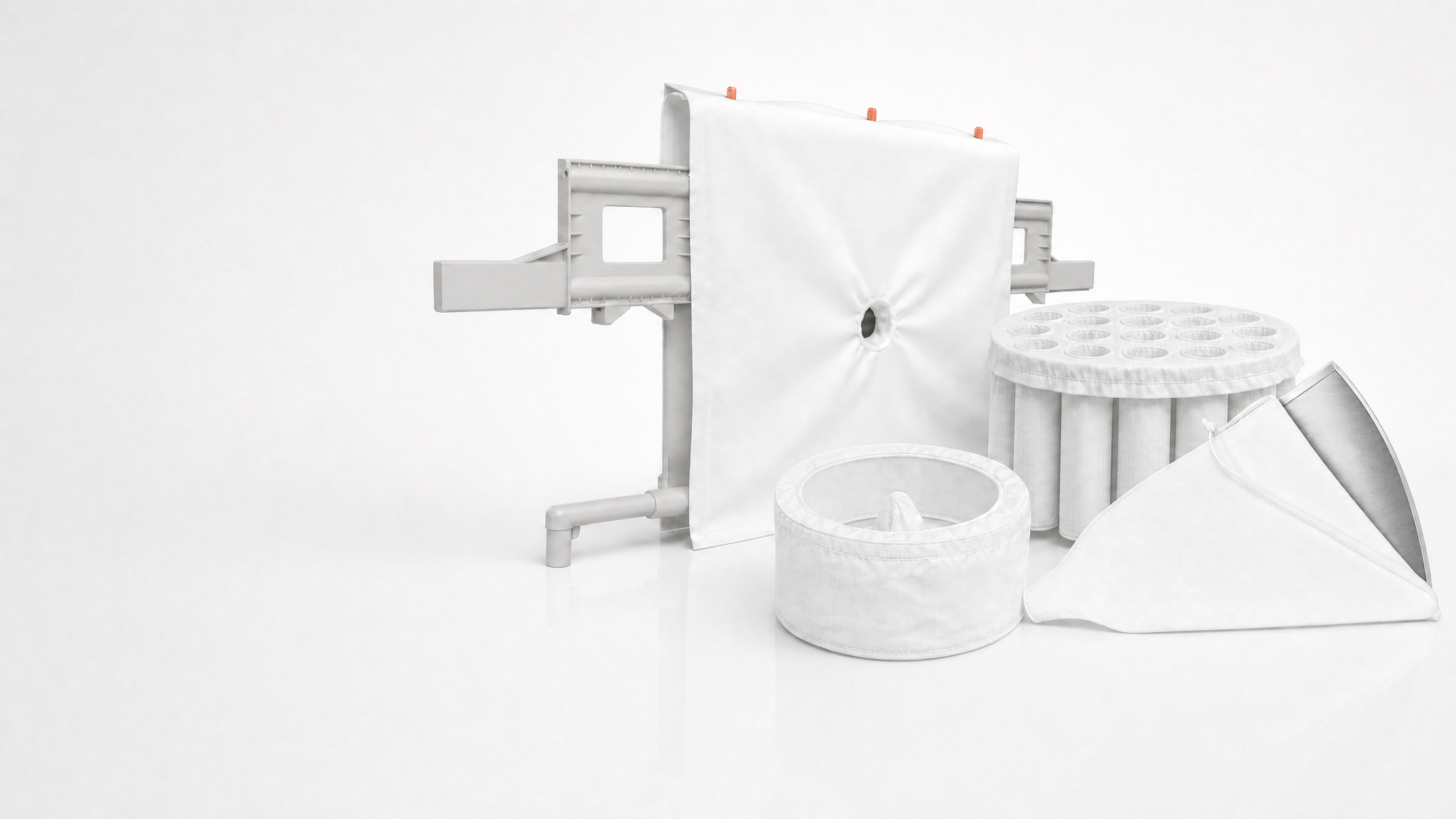
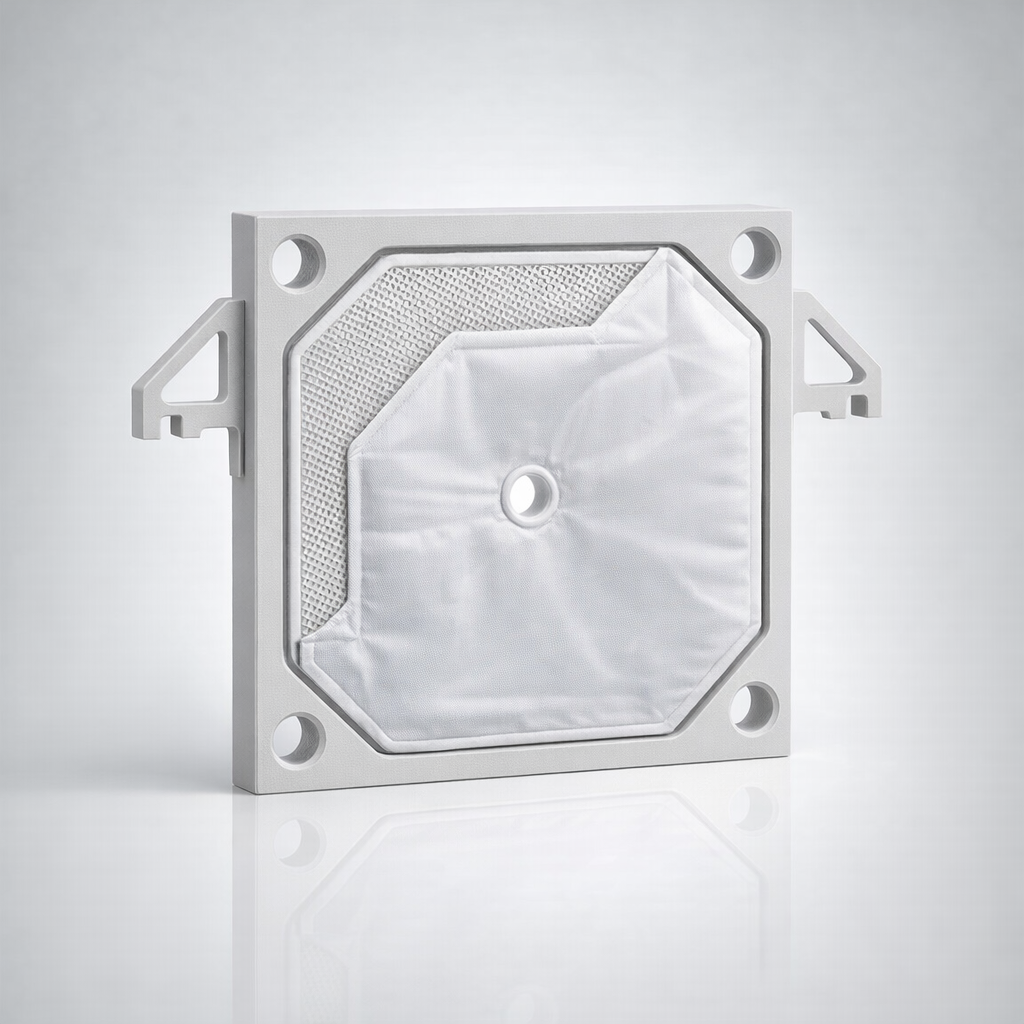
Filtering wax and wax-bearing suspensions in a chamber filter press places special demands on the filter cloth. While many solid–liquid separations focus on filtrate clarity and throughput, wax adds a further factor that often decides the economics of the process: the reliable detachment of the filter cake. If the wax cake clings to the cloth when the press opens, cleaning and cycle times increase, and residual wax can gradually seal the pores.
Why wax is so hard to release
Wax is highly temperature-dependent. If the filtration temperature is too high, the cake stays soft and tacky and adheres to the weave. If it is too low, viscosity rises and wax crystals progressively blind the pores. The workable process window between these two states is often narrow. On top of this comes the cloth surface: rough or highly structured weaves give the wax additional mechanical anchor points. Poor cake release therefore almost always results from the interaction of process conditions and cloth selection – not from a single cause.
The most common causes at a glance
- Filtration temperature too high: the cake is soft and tacky and will not release cleanly. Fix: review the temperature window and discharge only once the cake is sufficiently firm.
- Filtration temperature too low: viscosity rises, pores blind, cycle time and differential pressure increase. Fix: stabilise temperature control.
- Rough or structured weave: wax clings to yarn crossings and fibres. Fix: a smooth cake surface, preferably monofilament and a satin weave.
- Wrong pore size: too fine increases blinding, too coarse gives cloudy filtrate. Fix: match pore size to crystal size.
- Insufficient cloth cleaning: residual wax stays in the pores and performance drops each cycle. Fix: review the cleaning regime, temperature and medium.
A detailed comparison of causes and remedies is available on our page about poor cake release.
Choosing the right filter cloth for wax
For difficult cake release, a smooth, defined cake-side surface is preferable. Monofilament yarns in a satin weave create a smooth surface and offer the wax fewer mechanical anchor points. The correct pore size, however, still depends on wax crystal size, contaminants and the required filtrate clarity – too fine increases blinding, too coarse allows solids breakthrough. It is always a balance between clean release and adequate retention. Our RF-FF Series for filter presses offers graded fabric qualities and fabrication options for exactly this.
Material: PP, PET, PPS or PTFE?
Material selection depends on the real filtration temperature, pH, cleaning chemistry and pressure. PP offers good chemical resistance and interesting anti-stick behaviour but has temperature limits. PET has good mechanical properties for many applications, though its real service limit at sustained high temperatures must be checked. PPS and PTFE are interesting for high temperatures or very low surface energy, but are usually special solutions. We deliberately do not quote general temperature ratings before the real process data is known.
Preventing blinding and protecting service life
Wax residue can penetrate the weave during temperature changes and partly solidify. The result is rising filtration times, higher pump pressure and shorter cloth life – a pattern many operators also recognise from general filter cloth clogging. The decisive levers are a smooth, low-blinding surface, a pore size matched to the crystal size, a stable filtration temperature and a suitable cleaning regime. Good regenerability over the service life is as important as filtration fineness.
What we need to make a recommendation
The cloth is never selected independently of the process. For a reliable recommendation we need the wax type and composition, the temperature during filtration and when the press opens, the solids content and particle/crystal size, the press type with plate format and operating pressure, the required filtrate clarity, the currently used cloth and its failure pattern, and the cleaning process. In practice, a sample trial with several graded fabric qualities is often the fastest route to a robust selection.
Conclusion
Poor cake release in wax filtration is not a matter of chance – it has specific, addressable causes in both the process and the cloth. With the right combination of surface, pore size, material and stable temperature control, release can be significantly improved and cloth life extended. A structured starting point is our application page on wax filtration and the filter press cloth configurator. We are happy to analyse your specific case – get in touch.