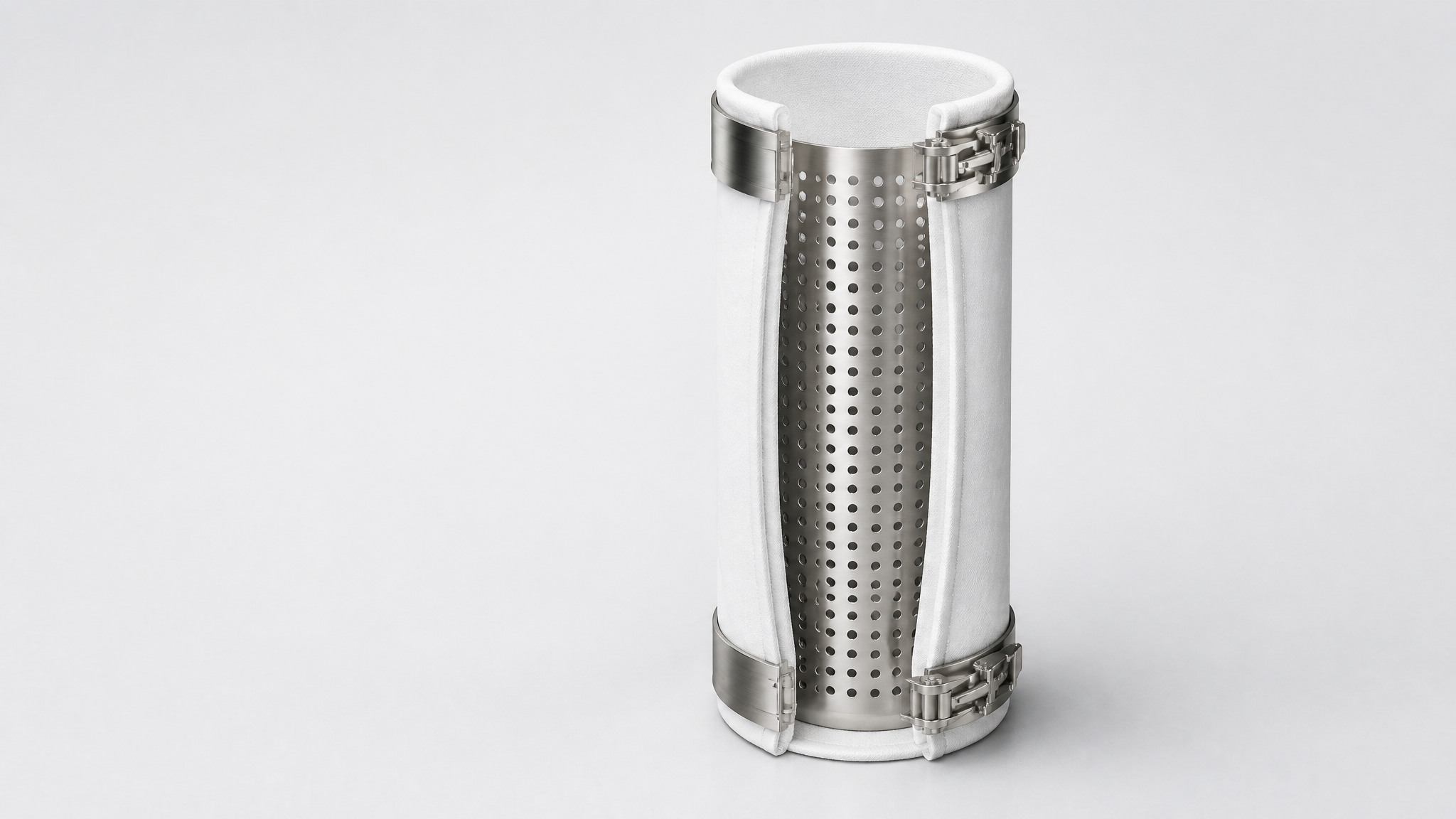
A simple design that is often underestimated in practice: a perforated pipe with a textile filter sleeve pulled over it. Water passes out through the perforation, the sleeve retains the solids and stops them being washed into the discharged flow. Whether such a solution works reliably almost always comes down to the same points – filtration fineness, material, fixation and mechanical load.
What a filter sleeve over a perforated pipe is for
In gravity dewatering or pressureless water discharge from a standpipe, the water should drain away freely while sand, sludge and fine particles are retained. The textile sleeve acts as a flat filter barrier directly on the pipe wall. Compared with a rigid screen, a fabric sleeve can be graded more finely, fabricated more easily and replaced when needed.
What matters in the design
- Filtration fineness: the pore size must match the smallest particle to be retained. Too coarse lets solids through; too fine increases flow resistance and the risk of blinding.
- Open flow area: the pipe perforation and the open area of the fabric must be matched so the required flow drains away without unnecessary pressure build-up.
- Fixation at the ends: the sleeve must sit tightly and securely on the pipe so that no water bypasses unfiltered at the ends. Clamps or bands are the usual solution here.
- Mechanical load: flow, abrasion at the perforation edges and recurring pressure changes determine how robustly the fabric and seams need to be built.
- Chemistry and temperature: water composition, pH, chlorides and temperature drive the material choice.
Material selection
Polypropylene (PP) is a robust standard for cold water: good chemical resistance, hydrolysis-stable and low water absorption, even with chlorides. Polyester (PET) offers higher mechanical and abrasion resistance but must be used within its chemical limits. Polyamide (PA) is very abrasion-resistant but absorbs water. For demanding chemistry or very low surface energy, PTFE or specialty solutions come into play. Which combination fits depends on the real process – we deliberately quote firm figures only once the operating data are known.
Cleaning without backflush
Not every installation offers a backflush. If the sleeve can only be cleaned from the outside, or not regularly at all, a smooth, blinding-resistant surface becomes more important so that solids do not settle permanently. Filtration fineness is then also a compromise between retention and service life.
The data we need for a recommendation
Pipe diameter and length, perforation pattern (hole diameter and open area), flow rate and pressure conditions, water composition and temperature, the smallest particle to be retained, the type of fixation and any cleaning options. On this basis we propose fabric, fineness and fabrication. More on our page about filter sleeves for perforated pipes and about fabrication & cutting.
Conclusion
A filter sleeve over a perforated pipe is structurally simple but demanding to specify: fineness, flow, fixation and material must all fit the specific case. Tell us about your application – get in touch.