
Filter Sleeves & Socks
Filter Sleeves for Perforated Pipes & Standpipes
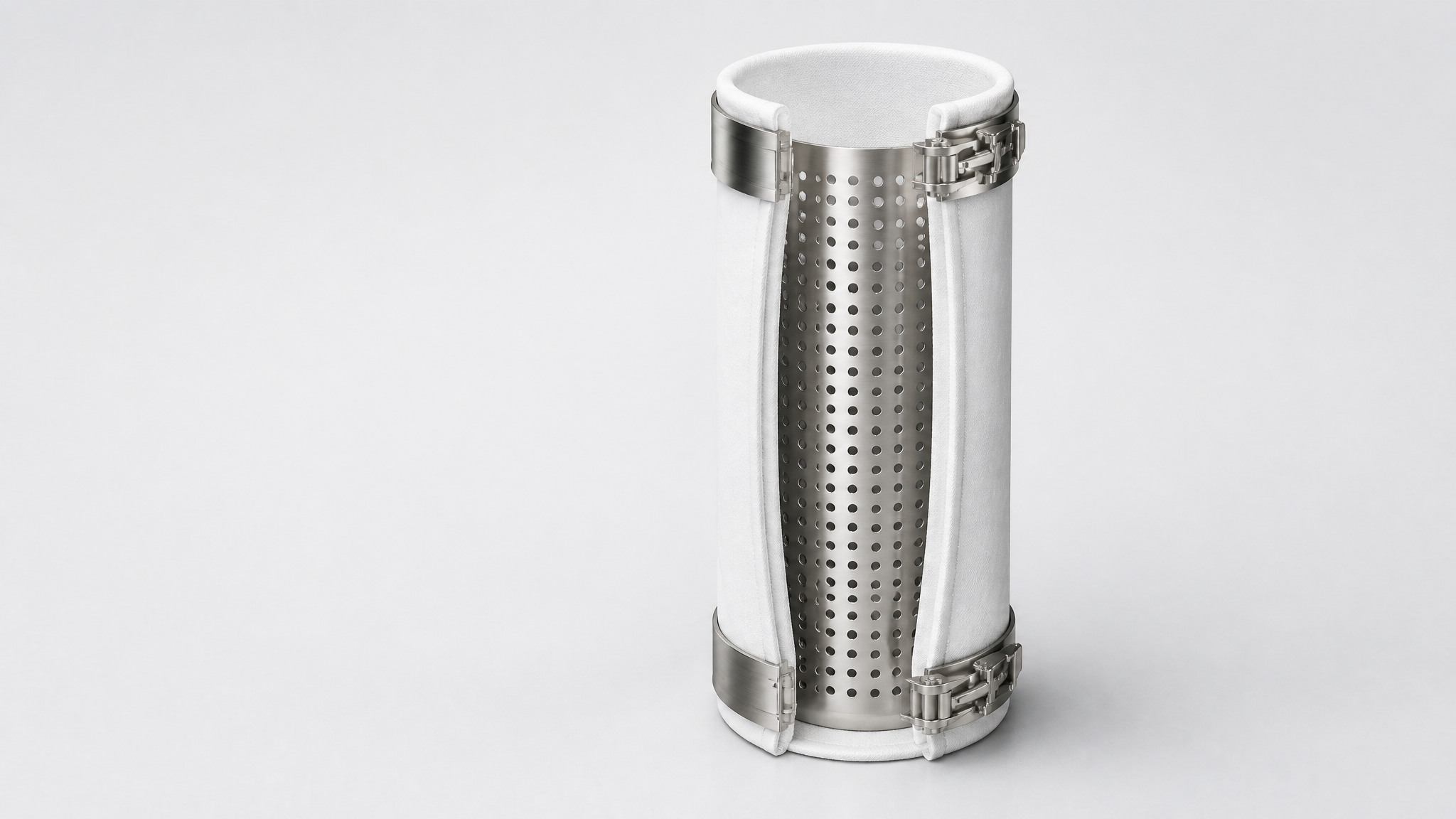
A fabric filter sleeve pulled over a perforated support pipe and fixed with stainless clamp bands is a simple, robust way to filter water flowing through the pipe wall — for gravity discharge, dewatering and drainage without applied pressure. We fabricate the sleeve to your exact dimensions, with the right medium, support and fixation for the duty.
A Proven Principle for Water Discharge
The idea is straightforward: a perforated pipe — often a stainless standpipe — carries the mechanical load and gives the assembly its shape, while a fabric sleeve pulled over the perforated section does the actual filtration. Water passes through the pipe wall and the fabric, solids are retained, and the clarified water is discharged. Because it works under gravity alone, no pressure vessel and no complex hardware are required.
It is a common arrangement in construction-water management, drainage and infrastructure applications — anywhere solids-laden water has to be discharged cleanly, and where a serviceable, exchangeable filter element is preferred over a fixed cartridge.
What decides whether it works well is the detail: the fabric matched to the required fineness, a support layer where the perforation is coarse, reinforced cuffs and a fixation that holds without cutting into the cloth.
How the Sleeve Is Built Up
A reliable sleeve is more than a tube of fabric. From the pipe outward we build up the element so that the fabric is evenly supported, protected from the perforation and easy to service.
Typical Applications
Wherever solids-laden water has to be discharged or dewatered through a pipe under gravity, a confectioned filter sleeve is often the simplest serviceable solution.
Construction-Water Management
Dewatering of construction sites, shafts and excavations — retaining fine solids before the water is discharged.
Tunnel & Infrastructure Drainage
Discharge of tunnel and infrastructure water carrying fine particles and traffic-related contamination.
Incident & Spill Chambers
Controlled discharge of collected water from incident/retention chambers to the receiving water.
Seepage & Leachate
Filtering seepage and leachate flows where a robust, exchangeable element is preferred.
Stormwater Treatment
Retaining suspended solids in stormwater and surface-water discharge arrangements.
Process & Service Water
Simple in-line solids retention on process- and service-water lines without a pressure housing.
Reliable Fixation
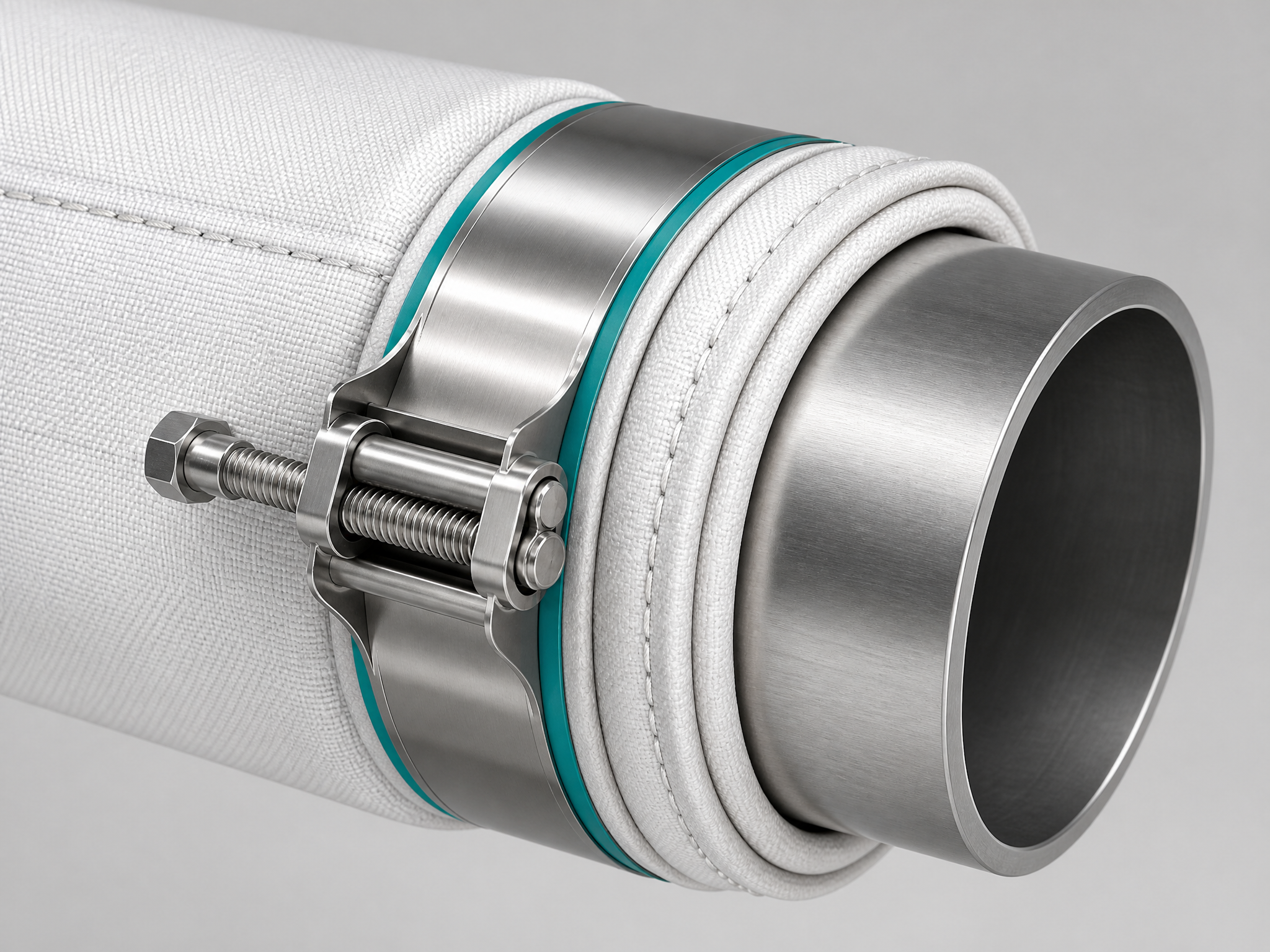
Stainless clamp bands are well suited to fixing the sleeve — provided the detail is right. The fixation has to hold the sleeve firmly against the head and any pull-off forces, without cutting into the fabric.
Media & Materials
The medium is chosen against the water chemistry, the required fineness and the cleaning regime. As a guide — the final recommendation follows once we have your operating data:
Polypropylene (PP)
Good chemical resistance, hydrolysis-stable and low water absorption — a robust default for ambient water, including chloride-bearing water.
Polyester (PET)
Higher mechanical and abrasion strength; a good choice where the sleeve sees mechanical load, within its chemical limits.
Polyamide (PA)
Very abrasion-resistant, but absorbs water — considered where abrasion dominates the duty.
PTFE / specials
For demanding chemistry or very low surface energy — a special solution when the standard polymers are not sufficient.
Woven monofilament media offer the best cleanability and lowest blinding; needle felts retain finer particles as depth media but blind faster and are harder to clean by hand. We match weave, fineness and construction to the solids and the discharge requirement.
Cleaning Without Backflush
If no automatic backflush or suction is planned, the element has to suit manual servicing. We recommend a smooth, low-blinding woven medium that can simply be hosed off, combined with a swap-out concept.
Keeping two or three spare sleeves per position means a fouled sleeve is exchanged in minutes and cleaned off-line — the discharge keeps running and cleaning is never rushed.
Know the Limits
A fabric sleeve is a solids filter, not an oil separator: free oil blinds the medium and emulsified oil passes through, so oily fractions belong in an upstream separation stage.
And every filter adds head loss — as the cloth loads, the level inside the standpipe rises. The maximum allowable backwater level is therefore a hard design limit that has to be respected when the fineness is chosen.
What We Need for a Recommendation
A sleeve is never specified in isolation from the application. To recommend the right medium, fineness and construction — and to prepare an offer — we need a few key details. If some are still open, send us what you have and we help you specify the rest.
Where useful, we are glad to send sample fabrics in graded qualities so you can run a settling or filtration trial with your real water before deciding.
Related Topics
How we fabricate the sleeve and the media it is made from.
Fabrication & Cutting
In-house confection of sleeves, bags and made-to-drawing elements — sewn or welded.
Learn MoreRoll Goods — Fabric by the Metre
The woven media and felts the sleeves are made from.
Learn MoreWastewater & ETP
Filter media for water and effluent treatment duties.
Learn MoreFine-Particle Filtration
What woven and felt media realistically retain in the fine range.
Learn MoreAll Filter Media & Products
The full portfolio of filter fabrics, felts and finished elements.
Learn MoreContact & Inquiry
Send your pipe data and water details for a technical assessment.
Learn MoreFrequently Asked Questions
Is a filter sleeve over a perforated standpipe a sensible design?
Yes. A fabric sleeve pulled over a perforated support pipe and fixed with clamp bands is a proven, low-maintenance way to filter water that flows through the pipe wall — typically for gravity discharge or dewatering without applied pressure. The perforated pipe carries the mechanical load; the fabric does the filtration. The key detail is matching the fabric, the support and the fixation to the perforation, the flow direction and the required fineness.
Why do you recommend a support mesh under the cloth?
Where the perforation is coarse, the fabric spans unsupported over each opening. Under load it bulges into the holes, which causes abrasion, uneven stress and local blinding. A coarse open support or drainage mesh between the pipe and the filter cloth keeps the fabric evenly backed, protects it from the perforation edges and keeps a free drainage path. We also recommend that the perforation edges are deburred, because burrs cut into any fabric.
Can the sleeve be cleaned without backflushing?
Yes, but the construction has to suit manual cleaning. Without an automatic backflush or suction device we recommend a smooth, low-blinding woven medium that can be hosed off, together with a swap-out concept: keep two or three spare sleeves per position so a fouled sleeve can be exchanged in minutes and cleaned off-line. Which weave and fineness clean best depends on the solids and should be confirmed against your operating data.
Will the sleeve remove oil and grease from the water?
A fabric filter is not an oil separator. Free oil tends to blind the medium and is hard to wash out by hand, while emulsified or dissolved oil passes through. If the water carries oils or greases — as surface and traffic-influenced water often does — an upstream oil or coalescence separation stage should handle that fraction before the water reaches the sleeve.
What retention (micron rating) can I expect?
It depends on the medium. Smooth monofilament wovens realistically cover a coarse-to-medium range, while finer retention moves towards needle felts, which act as depth media but blind faster and are harder to clean by hand. Fine dusts such as brake dust are largely in the low-micron range, so retention expectations must be set honestly against your discharge limit. We select the medium once the required fineness or the discharge limit values are known.
Can you supply the sleeve confectioned to my dimensions?
Yes. We fabricate filter sleeves and tubes to your exact length and diameter — sewn or welded — with reinforced, double-hemmed ends, optional drawstring or clamp channels, and an optional support mesh underlayer. We can also supply spare sleeves for the swap-out concept. Send us the pipe dimensions and we confirm the construction with you.
Filtering water through a perforated pipe or standpipe?
Send us your pipe dimensions and water details. We assess the design, recommend the medium and fineness, and fabricate the sleeve to your exact size — with sample fabrics for a trial if that helps.
Request a Technical Assessment