
Application — High-Temperature Filtration
Battery Material & Precursor Filtration
Hot alkaline chemistry, sub-micron precipitated fines and contamination limits measured in parts per million. The element itself has to be as clean as the product it produces.
Three Constraints That Rarely Coexist
Cathode precursor production puts a filter fabric under a combination that is unusual even by chemical-industry standards. The precipitation and washing steps run hot and alkaline. The particles are precipitated hydroxides or carbonates — fine, often compressible, and very good at blinding a fabric that was chosen on nominal retention alone. And the product carries contamination limits that make the filter element itself a potential source of failure.
Each of those three is manageable on its own. Together they eliminate most standard answers. A fabric fine enough for the fines may blind under the hot liquor. A polymer chosen for the temperature may shed fibre. A robust sewn construction may introduce exactly the metal the product cannot tolerate.
We therefore treat the fabric, the confection and the hardware as one specification, and we are explicit about which requirements can be met by fabric selection and which need a process or downstream answer.
Typical Process Steps
What We Optimise For
In battery material duties the priorities are different from a mining or wastewater application. These are the objectives we work against.
Contamination Control
Metal parts specified by grade, welded or ultrasonically sealed edges where the polymer allows, and fibre migration treated as a design criterion rather than an accepted side effect.
Hot Alkaline Stability
Polypropylene covers much of the range and is hydrolysis-stable, but runs out of temperature near 90 °C. Above that, PPS, PVDF, PEEK or PTFE — and not polyester, which hydrolyses in hot caustic well below its dry rating.
Cake Release & Washing
Washing efficiency depends on an even, crack-free cake. A smooth, low-anchoring surface builds a thin releasable cake and lets wash liquor pass uniformly instead of channelling.
Fines Retention Without Blinding
Precipitated fines are compressible. We aim for a surface that filters on itself rather than in itself, and use a two-layer construction where clarity demands it.
Repeatable Residual Moisture
Downstream drying and calcination costs are driven by cake moisture. Consistent, predictable dewatering matters more than a best-case figure achieved once.
Element Format & Cleanability
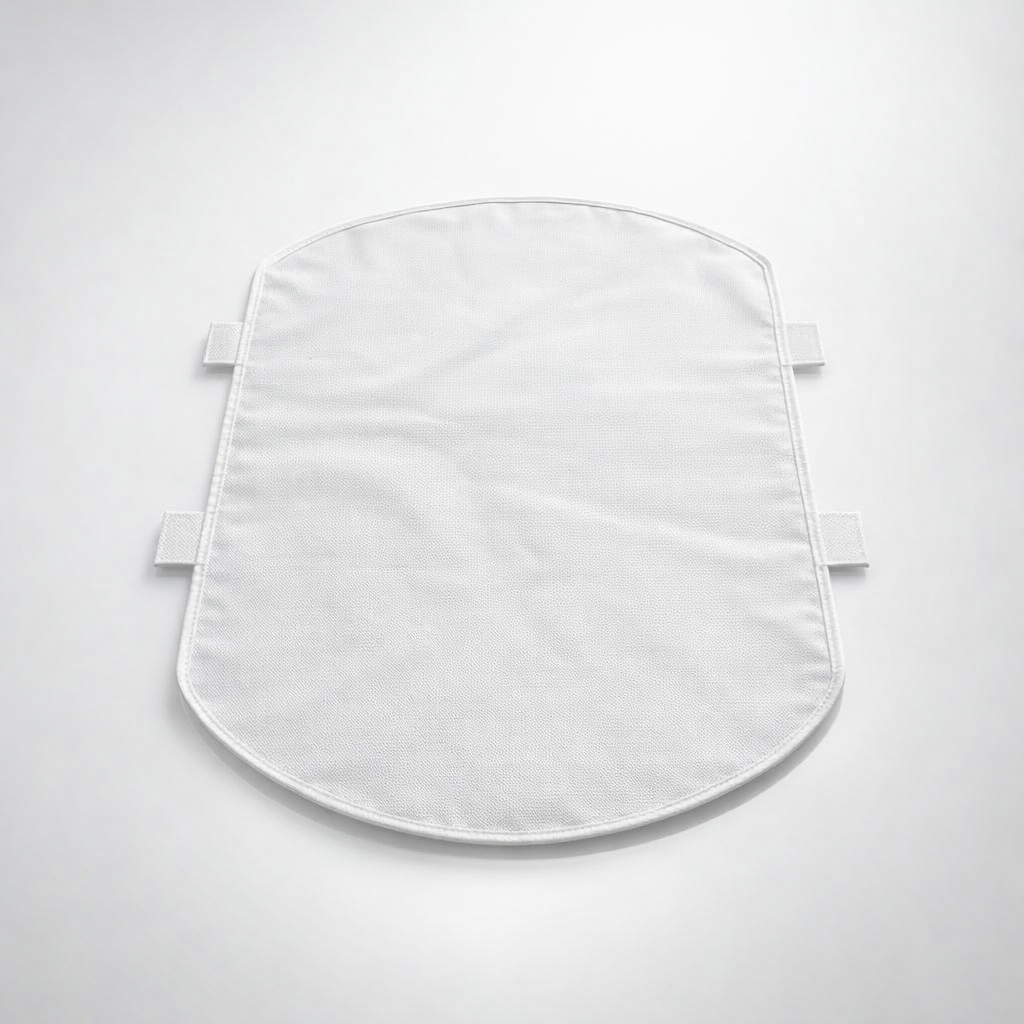
Nutsche bags, centrifuge bags, press cloths, belts or cut parts — the format decides how much confection is involved and therefore how many contamination sources exist.
An Honest Note on Purity Claims
No textile filter medium is genuinely fibre-free, and we will not tell you otherwise in order to win an order. What is achievable is a large reduction in migration: monofilament surfaces shed far less than staple-fibre constructions, welded and ultrasonically sealed edges remove cut fibre ends, and the finishing process can be specified to take loose material out before delivery.
Where a process genuinely cannot tolerate any fibre, the right answer is a combination — a low-shed primary cloth plus a downstream polishing stage — not a claim about the cloth. We would rather tell you that before you order than explain it afterwards.
What We Need to Specify the Element
Related Topics
High-Temperature Filtration
Polymer limits, dry vs. wet heat, confection and cost logic.
Learn MoreHot Caustic & Alkaline Liquors
Where hot alkali, not temperature alone, decides the polymer.
Learn MoreFine-Particle Filtration
Retaining fines without blinding the fabric.
Learn MoreContamination & Stitching
Fibre migration, seam design and product contamination.
Learn MoreNutsche Filter Bags
Welded, low-shed elements for high-purity duties.
Learn MoreSpecialty Fabrics — PEEK, PPS, PTFE
The high-performance polymers with temperature and pH data.
Learn MoreFrequently Asked Questions
Which filter fabric is used for cathode precursor (pCAM) filtration?
The decision is driven by three things at once: the temperature of the precipitation and washing steps, the pH of the liquor, and the contamination limits of the product. Polypropylene covers a great deal of this work — it is hydrolysis-stable and tolerates the full pH range as an orientation figure, but runs out of temperature around 90 °C. Where the hot alkaline washing step goes above that, PPS, PVDF, PEEK or PTFE become the realistic choices. Polyester, despite its higher dry-heat rating, is often the wrong answer here because hot caustic causes hydrolysis well below that rating.
Why are purity requirements so critical in battery material filtration?
Battery-grade materials carry contamination limits in the parts-per-million range for specific metals, and the filter element is a potential source. Metal eyelets, rings, clamping strips and staples can all contribute, as can fibre shed from a poorly finished fabric. This is why we favour welded and ultrasonically sealed constructions over sewn ones wherever the polymer allows it, specify the grade of every metal part explicitly, and treat fibre migration as a design criterion rather than an afterthought.
How do you handle very fine precipitated particles?
Precipitated hydroxide and carbonate particles are fine and often compressible, so a fabric chosen purely on nominal retention will blind. The workable route is a smooth, low-anchoring surface — typically monofilament or a calendered construction — that builds a thin, releasable cake rather than driving fines into the weave. Where clarity requirements are very strict, a two-layer construction with a fine surface over an open support carries the pressure without collapsing the pore structure.
Can filter elements for battery material be supplied fibre-free?
No fabric is genuinely fibre-free, and we will not claim otherwise. What can be done is to minimise migration: monofilament surfaces shed far less than staple-fibre constructions, edges can be welded or ultrasonically sealed instead of cut and sewn, and the finishing process can be specified to remove loose material. Where the process is extremely sensitive we recommend combining that with a downstream polishing stage rather than relying on the primary cloth alone.
What do you need in order to specify an element?
The process step — precipitation, primary filtration, washing or final dewatering — the temperature and pH of each, the machine type and element format, the solids concentration and particle size distribution, the required residual moisture and washing efficiency, the contamination limits that apply to the product, and the current element with its observed failure or performance shortfall.
Precursor filtration with purity limits and a hot alkaline wash?
Send us the process step, the temperature and pH, the element format and your contamination limits — we will propose a fabric and a confection built around them.
Send Inquiry