
Application — High-Temperature Filtration
Sugar & Starch Filtration
Hot juice, syrup and hydrolysate — a wet-heat duty where the cleaning cycle usually sets the real service life, and where the datasheet temperature figure is the wrong number to select on.
A Wet-Heat Duty, Not a Hot-Air Duty
Sugar and starch processing is filtered hot because viscosity and solubility demand it. But the heat always arrives with water — and that is the distinction that decides the polymer. Datasheet temperature figures are dry-heat values. In hot water, hot syrup or a hot alkaline wash, hydrolysis becomes the dominant ageing mechanism and it operates well below the printed limit.
This is why polyester, which looks like the obvious strong and economical choice, is a risky default here. It does not soften and go slack; it embrittles. A cloth can look intact and still crumble when you flex it. Polypropylene, with a lower nominal rating but genuine hydrolysis stability, often outlasts it in exactly this service.
The second recurring issue is blinding. Starch, pulp fines and carbonatation lime are compressible and sticky, and a fabric chosen on nominal retention drives them into the weave rather than building a cake on it. Once that has happened, mechanical cleaning rarely brings the permeability back.
Typical Duties
What We Optimise For
These are the objectives that decide whether a cloth survives a full campaign or has to be changed mid-season.
Hydrolysis Resistance First
Wet heat, not dry heat, sets the material. Polypropylene to roughly 90 °C; above that PPS, PVDF or PTFE. Polyester is selected only where the wet-heat and alkaline exposure genuinely stays low.
The Cleaning Cycle as Design Case
Hot caustic CIP, steam and hot backwash are often more aggressive than the process. We specify against the harshest event in the cycle, not the average condition.
Anti-Blinding Surface
A smooth monofilament or calendered surface lets a sticky, compressible cake build on the fabric instead of inside it — and lets a wash actually restore permeability.
Stable Throughput Over a Campaign
A cloth that starts brilliantly and fades is worse than one that runs flat. We select for the cycle-100 performance, not the cycle-one figure.
Hygienic Confection
Smooth seams without cavities, welded edges where the polymer allows, and hardware that can be cleaned rather than merely rinsed.
Element Format & Fit
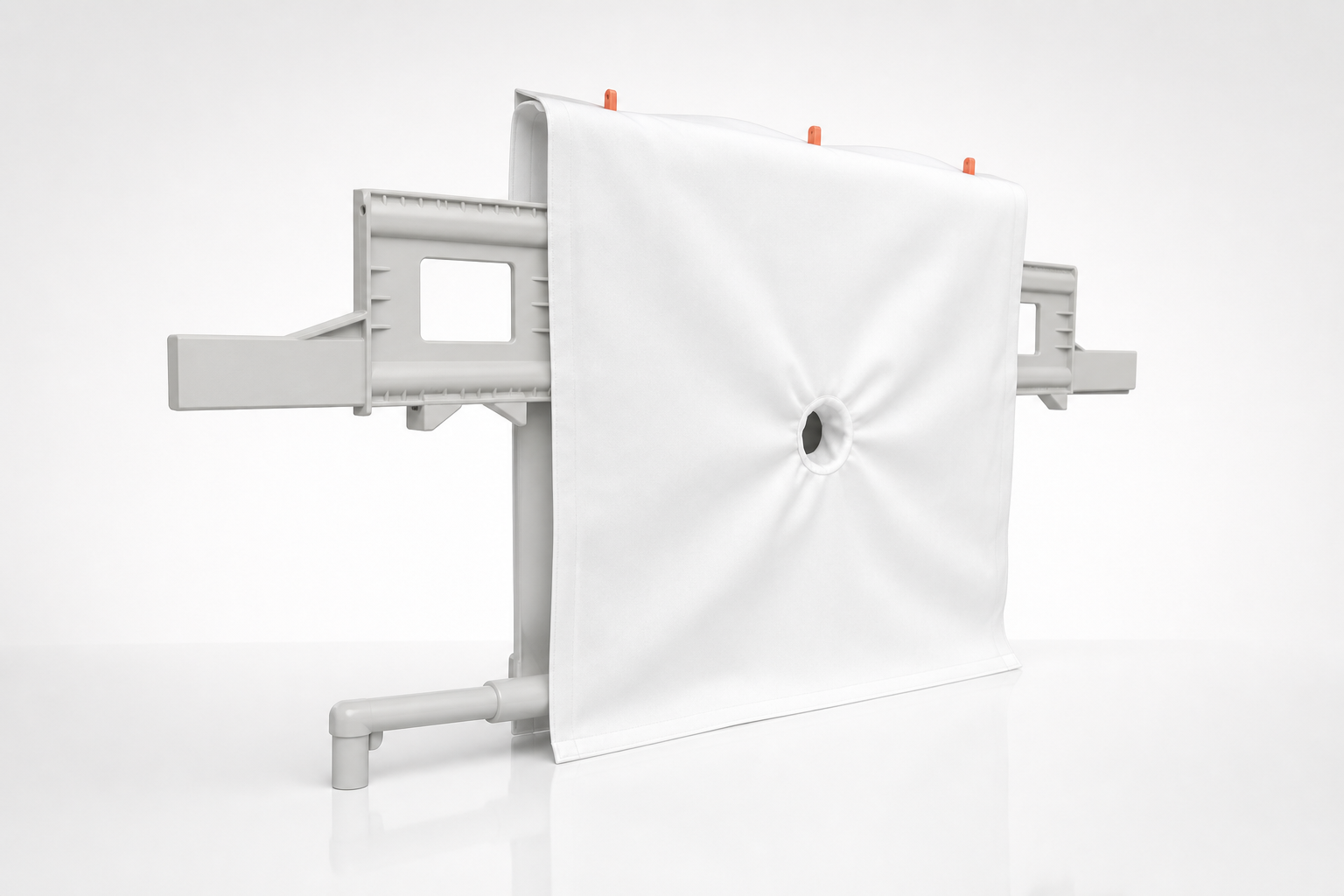
Filter press cloths, pressure leaf elements, belts, candles or centrifuge bags — the format and the fixing decide which constructions are realistic.
Food-Contact Service — What We Can and Cannot Say
We can supply fabrics in polymer and finish combinations intended for food-contact service, and we can pass on the corresponding material documentation from our supply chain.
What we will not do is imply more than that. We are a fabric and confection manufacturer, not a certification body, and we hold no food-safety certification of our own. If your quality system requires specific declarations or traceability, raise it at the enquiry stage — we would rather confirm what is available up front than have you discover a gap after delivery.
What We Need to Recommend a Fabric
Related Topics
High-Temperature Filtration
Polymer limits, dry vs. wet heat, confection and cost logic.
Learn MoreHot Caustic & Alkaline Liquors
The mechanism behind hydrolysis failures in hot alkaline service.
Learn MoreFilter Cloth Clogging
Why fabrics blind and what actually restores permeability.
Learn MoreActivated Carbon Filtration
The neighbouring duty in decolourisation circuits.
Learn MoreFilter Press Cloths
Chamber and membrane press cloths for juice and syrup duties.
Learn MoreSpecialty Fabrics — PPS, PVDF, PTFE
The polymers for the hot end of the process.
Learn MoreFrequently Asked Questions
Which filter fabric is suitable for hot sugar juice filtration?
Sugar juice and syrup filtration is a wet-heat duty, and that changes the material logic completely. Polyester carries a high dry-heat rating but hydrolyses in hot water and hot alkaline conditions well below it, which is why it is a risky default here despite looking attractive on paper. Polypropylene is hydrolysis-stable and tolerates the full pH range as an orientation figure, but is limited to roughly 90 °C continuous. Where the juice or the cleaning cycle runs hotter, PPS, PVDF or PTFE are the realistic options.
Why does the cleaning cycle matter more than the process temperature?
In many sugar and starch plants the process itself is comfortable and the clean-in-place step is not. A hot caustic wash, a steam sterilisation or a hot water backwash is frequently the most aggressive event in the whole cycle — and it is the one most often left off the specification sheet. If the fabric is selected for the process only, the cleaning regime quietly sets the real service life.
What causes filter cloths to blind in starch dewatering?
Starch and its by-products are fine, sticky and highly compressible, so a cloth chosen on nominal retention alone drives particles into the weave rather than building a cake on top of it. The workable route is a smooth, low-anchoring surface — monofilament or calendered — that filters on itself. Once a fabric has blinded with starch, a purely mechanical clean rarely restores permeability; the cleaning chemistry and temperature have to be part of the design.
Are the fabrics suitable for food-contact processing?
We can supply fabrics in polymer and finish combinations intended for food-contact service and provide the corresponding material documentation from our supply chain. To be clear about what we are and are not: we are a fabric and confection manufacturer, not a certification body, and we do not hold food-safety certification of our own. Where your quality system requires specific declarations, tell us at the enquiry stage so we can confirm what documentation is available before you commit.
What do you need in order to recommend a fabric?
The process step — juice clarification, syrup polishing, carbonatation lime filtration, hydrolysate filtration or starch dewatering — the temperature and pH of the process and of the cleaning cycle, the machine type and element format, solids content and particle size, the required filtrate clarity or residual moisture, the cleaning chemistry, and the current fabric with its observed failure pattern.
Cloths failing mid-campaign in hot juice or starch service?
Send us the process step, the temperature and pH, and above all your cleaning cycle — in this duty the wash is usually what decides the service life.
Send Inquiry