
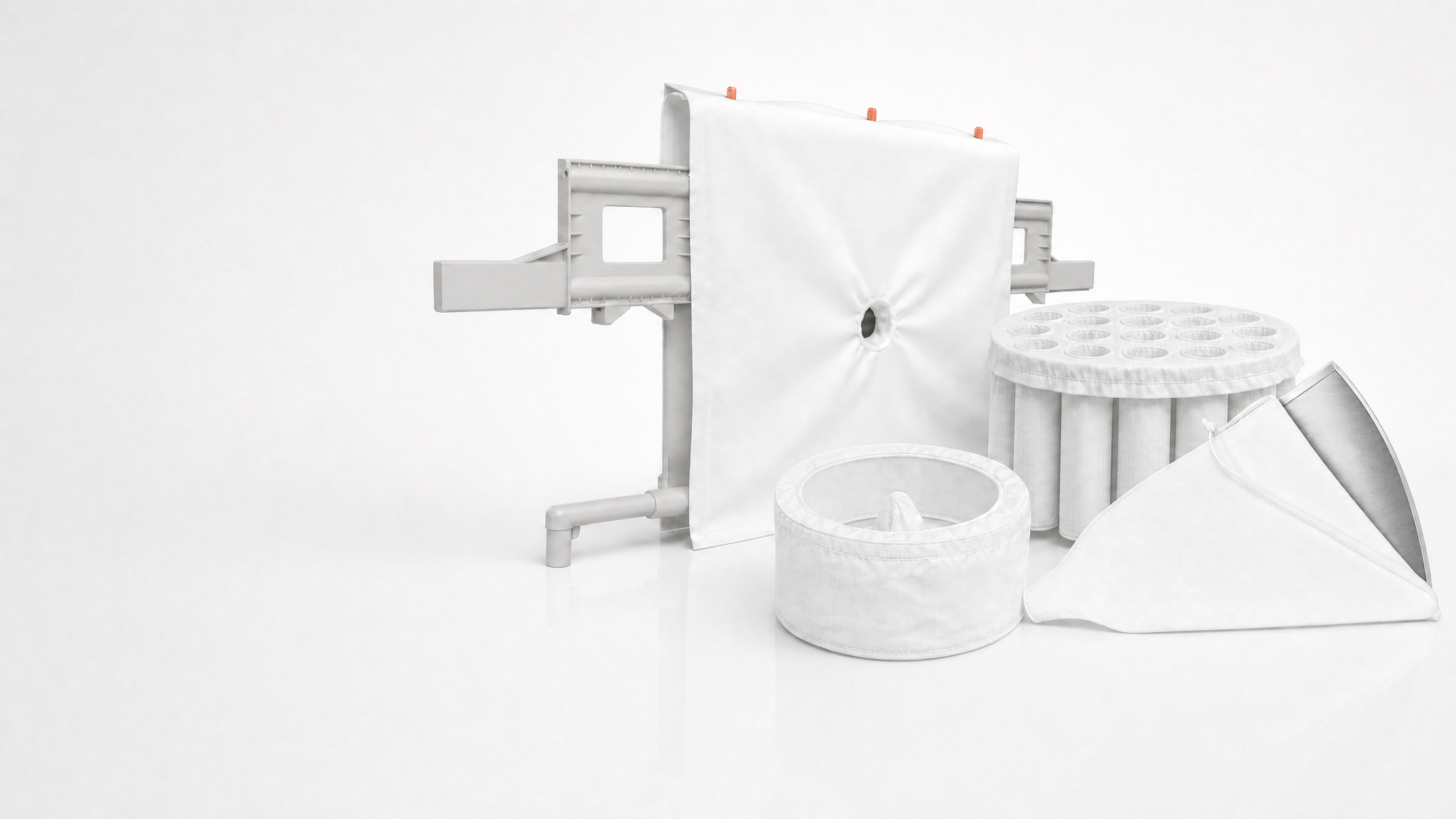
Application
Filter Cloths for Fine-Particle Filtration in Filter Presses
Blinded cloths, cloudy filtrate or wet cake when filtering pigments, titanium dioxide or kaolin? We analyse the process and the filter cloth and develop a fabric solution engineered for high solids retention, a clear filtrate and reliable dewatering of ultra-fine solids.
The Challenge with Ultra-Fine Solids
Filtering pigments, titanium dioxide, kaolin and similar ultra-fine products places some of the toughest demands on filter cloths for chamber and membrane filter presses. The particles are often sub-micron, build a dense, high-resistance cake and migrate deep into the weave.
The result is a strong tendency to blind the cloth, slowing filtration and shortening cycles — while an over-open surface lets fines break through and clouds the filtrate. Fine cake also drains slowly and holds a lot of water.
The right cloth walks this line: a cake-side surface fine enough to retain and clarify, open enough to keep filtering — always matched to the real particle-size distribution.
Typical Fine-Particle Filtration Challenges
What We Optimise Filter Cloths For
For fine-particle filtration, retention and permeability must be balanced with precision. These objectives guide the technical selection and the fabric engineering.
Fine Solids Retention
Sub-micron pigment, titanium dioxide and kaolin particles must be retained. We match the cake-side pore size to the real particle-size distribution for reliable retention.
Clear Filtrate
A clarifying cake must build quickly without breakthrough. We select a fine, smooth surface that produces a clear filtrate from the first cycle.
Low Blinding & Regenerability
Fine solids migrate into the weave. We optimise for stable permeability over the service life and reliable regeneration after each cycle.
Dewatering & Cake Moisture
Fine cake holds water. We select a surface and pore structure that keep drainage open so the cake reaches a lower residual moisture.
Cake Release & Material Fit
Fine cake can stick to the cloth. We match construction, finish and polymer to the product, the chemistry and the required clean release.
Press Geometry & Fabrication
Through-cloth, overhang or single cloth, plate format and hole pattern, neck, edge sealing and reinforcement, backing cloth and seam design all belong to a working solution.
Common Causes of Poor Performance with Fine Products
Blinding, cloudy filtrate and slow filtration usually have a specific, addressable cause. This overview links the typical root causes to the direction we take when optimising the cloth and the process.
| Cause | What happens | Optimisation approach |
|---|---|---|
| Pore size too coarse for the fines | Fine solids break through; cloudy filtrate. | Finer, more retentive cake-side surface matched to the particle-size distribution. |
| Pore size too fine | Rapid blinding, rising pressure, short cycles. | Balance retention against permeability; avoid over-fine selection. |
| Surface too open or rough | Deep particle penetration and poor cake release. | Smoother, denser cake-side surface with a suitable finish. |
| Dense, high-resistance cake | Slow filtration and long cycle times. | Optimise surface, pore structure and cake build for faster filtration. |
| Insufficient membrane squeeze / blow-down | High residual cake moisture and disposal weight. | Optimise squeeze pressure, blow-down, drainage and cake build. |
| Poor cake release | Cake sticks; manual intervention and downtime. | Match construction, finish and polymer for a clean release. |
| Insufficient cloth cleaning | Residual fines stay in the pores; performance drops each cycle. | Review cleaning regime, temperature, medium and cloth-change interval. |
What We Need to Specify the Right Cloth
The cloth is never selected independently of the process. For a reliable recommendation we ask for the following — and, where useful, we run a sample trial with several graded fabric qualities.
Configure your filter press cloth online
Answer a few guided questions about your application and receive a near-complete specification with a pre-filled inquiry. Skip anything you are unsure about.
Related Topics
Explore the machine, the underlying problems and related applications.
Filter Cloths for Filter Presses
The hub page for chamber and membrane filter press cloths.
Learn MoreFilter Cloth Clogging
Blinding, rising pressure and falling throughput — and how to fix it.
Learn MoreCake Release Problems
Sticky fine cake that will not release cleanly — and how to fix it.
Learn MoreActivated Carbon Filtration
Fine carbon retention and breakthrough in filter presses.
Learn MoreChemical Industry
Filter press cloths for chemical process filtration.
Learn MoreFind My Filter Fabric
Configure a filter press cloth against your process in a few steps.
Learn MoreFrequently Asked Questions
Why are pigments, titanium dioxide and kaolin so difficult to filter?
These products consist of ultra-fine, often sub-micron particles that build a dense, high-resistance cake and migrate deep into the weave. The result is a strong tendency to blind the cloth, slow filtration and, at the same time, a risk of solids breakthrough into the filtrate if the surface is too open. Fine-particle filtration therefore needs a cloth whose cake-side surface is matched precisely to the particle character — fine enough to retain and clarify, open enough to keep filtering.
How do I get a clear filtrate without blinding the cloth?
Filtrate clarity and permeability pull in opposite directions with fine solids. The lever is a cake-side surface with a pore size and finish matched to the real particle-size distribution — fine and smooth enough to retain the fines and build a clarifying cake quickly, without being so tight that it blinds. A stable initial filtration and a suitable cleaning regime keep that balance across the service life.
Which cloth construction suits pigment and titanium dioxide filtration?
Fine products usually call for a dense, smooth cake-side surface — fine multifilament or tightly woven constructions, sometimes with a calendered or singed finish to slow particle penetration and support cake release. The exact weave, finish and backing are selected against the product, the required clarity and the press. We match the construction to your real filtration behaviour rather than to a generic product family.
How do I reduce cake moisture with fine pigment or kaolin cake?
Ultra-fine cake holds a lot of water and drains slowly. The levers are a surface that keeps drainage open despite the fine solids, a pore structure matched to the particles, effective membrane squeeze and blow-down, and a stable, even cake build. Fabric surface and fabrication, together with the press settings, decide how dry the cake gets.
What information do you need to recommend a fine-particle filter cloth?
To engineer a reliable recommendation we need the product and its particle-size distribution (pigment, titanium dioxide, kaolin or similar), the solids content, the required filtrate clarity and residual cake moisture target, the temperature and any chemistry, the press type, plate format and operating pressure, the currently used cloth and its failure pattern, and the cleaning process. A sample trial with several graded fabric qualities is often the fastest route to a robust selection.
Blinding or cloudy filtrate in fine-particle filtration?
Tell us about your product, particle-size distribution, required filtrate clarity and current cloth — we will recommend a fabric engineered for fine retention, a clear filtrate and reliable dewatering.
Send Inquiry