
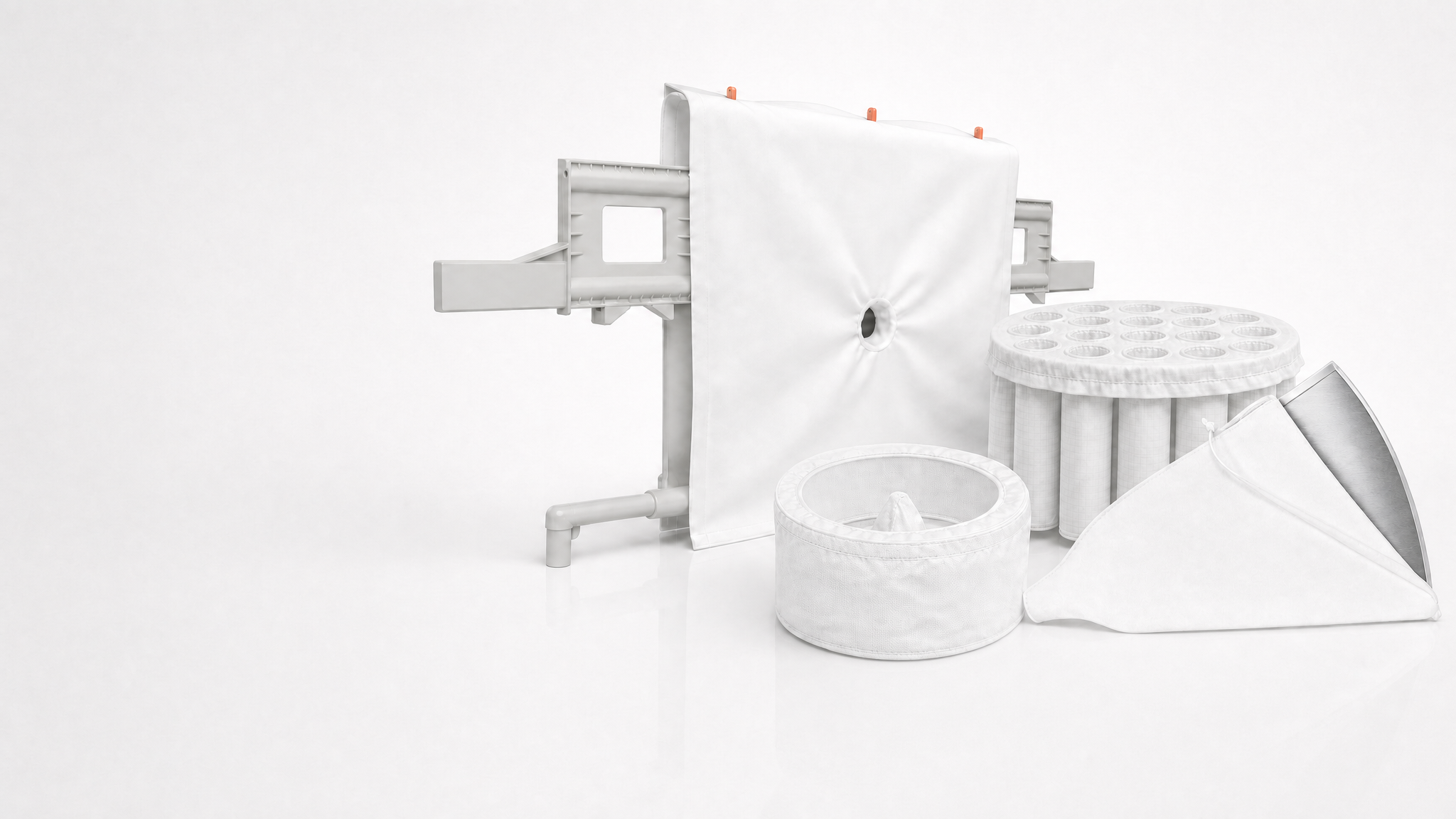
When your process runs above 100°C, filter fabric selection becomes a reliability decision, not just a procurement task. The wrong material can shrink, embrittle, hydrolyze, or lose strength long before the rest of the process is ready for maintenance. This guide helps operators choose the right temperature-rated fabric for long service life, stable filtration, and lower total cost.
🔑 Key Takeaways
- Temperature rating is not enough — moisture, chemicals, and cycle time can reduce real-world performance.
- Match the fabric to the process — PET, PA, PPS, aramid/Nomex, and PEEK each cover different thermal windows.
- Safety margin matters — operate below the nominal maximum to protect seam strength, permeability, and cake release.
- Premature failure is expensive — the cheapest fabric often costs more in downtime, leakage, and changeouts.
💡 Tip: If you are unsure about the fabric grade, start with the Solution Finder to find and configure the right filter fabric online and receive a pre-filled, non-binding specification for your inquiry.
⚙️ Why Temperature Rating Is Only Part of the Story
At elevated temperatures, the fabric is exposed to more than heat alone. Heat accelerates thermal oxidation, weakens fibers over time, and can reduce seam and edge stability. In wet processes, hydrolysis may become the real failure mechanism, especially when hot water, steam, or condensate is present.
That means a fabric may technically survive the temperature but still fail early because of the chemistry around it. For example, a filter cloth in a hot slurry line may degrade faster than the same fabric in a dry gas stream. That is why process temperature, pH, moisture, and cycle duration must be evaluated together.
🔬 Material Selection Guide: PET, PA, PPS, Aramid, and PEEK
| Material | Typical Temperature Capability | Best Fit | Main Operator Watch-Out |
|---|---|---|---|
| PET | Up to 150°C | General industrial filtration, moderate heat | Hydrolysis risk in hot, wet service |
| PA | Up to 120°C | Lower-temperature processes with good mechanical demand | Limited hot-wet stability |
| PPS | Up to 190°C | Hot chemical and dust-laden process filtration | Confirm chemical compatibility and seam design |
| Aramid / Nomex | 200°C+ | Very hot processes, harsh thermal loading | Needs correct safety margin to avoid brittleness |
| PEEK | Up to 260°C | Extreme temperature and demanding chemistry | Use where the added cost is justified by uptime |
PET is often the first choice for processes that are warm but not extreme. It offers a good balance of cost and performance, but in hot, moist conditions it can lose strength through hydrolysis. PA can work in moderate heat, but it is not the preferred option for long exposure above 120°C.
PPS is a strong industrial workhorse for elevated temperatures, especially where chemical resistance matters. Aramid/Nomex becomes relevant when heat is consistently high and the fabric must hold shape under stress. For the most demanding applications, PEEK provides the highest thermal headroom, but it is usually selected only when the process truly needs that margin.
🛠️ How Thermal Degradation Shows Up in the Plant
In day-to-day operation, heat damage rarely appears as a sudden failure. More often, operators notice a gradual change in performance:
- Longer filtration cycles and slower dewatering
- Loss of cake release or sticky residue on the cloth
- Edge fraying, seam distortion, or holes near support points
- Reduced permeability after repeated thermal cycling
- Unexpected drip leakage or solids bypass
On a filter press, this can mean poor cake discharge and increased wash time. On a centrifuge, the issue may show up as fabric distortion under heat and speed. If you run a RF-BF Series belt filter fabrics or a RF-FF Series filter press fabrics, the correct thermal margin can make the difference between steady production and frequent emergency changeouts.
⚠️ Caution: Do not select a fabric based only on the published maximum temperature. Always account for hot washing, steam cleaning, alkalinity, acid exposure, and thermal cycling. These factors can reduce the effective service limit significantly.
📊 Testing Thermal Stability Before Full-Scale Use
Before committing to a full production run, it pays to verify how the fabric behaves under your actual process conditions. A small lab test or pilot run can reveal issues that datasheet numbers will not show.
Test heat-up, hold time, cool-down, and cleaning temperature, not just one static number.
Measure tensile stability, seam integrity, and dimensional change after thermal cycling.
Confirm permeability, cake release, and particle retention with the actual slurry or dust load.
Choose a fabric rated above your normal setpoint so real process fluctuations do not push it to failure.
Rule of thumb: For hot, wet service, keep the fabric’s nominal maximum at least one material class above your normal operating temperature whenever possible.
🏭 Where High-Temperature Fabrics Pay Off
High-temperature fabrics are especially valuable in processes where heat, chemistry, and uptime all matter at once:
- Wax filtration — hot waxes can solidify fast, so the fabric must tolerate heat while still releasing cake cleanly.
- Hot oil processing — temperature stability and low contamination risk are essential.
- FGD — flue gas desulfurization can combine heat, moisture, and aggressive chemistry.
- Geothermal — hot, mineral-rich fluids can accelerate wear and fouling.
- Cement — thermal load, abrasion, and dust density make material choice critical.
For these applications, the right fabric is not an upgrade — it is a cost control measure. A properly selected material reduces cloth change frequency, lowers shutdown risk, and helps maintain throughput. That is especially important in systems like chemical industry filtration, cement and bulk solids applications, and mining processes where unplanned downtime is expensive.
📋 Pre-Selection Checklist for High-Temperature Fabric
- What is the normal operating temperature, and what are the peaks?
- Is the process dry, wet, or exposed to steam/hot cleaning?
- Which chemicals, pH levels, or solvents are present?
- What machine are you using: press, centrifuge, belt, Nutsche, or dryer?
- How costly is downtime compared with the fabric price?
🧪 Choosing the right R+F fabric for the machine
R+F FilterElements covers the full high-temperature range with engineered fabrics for different equipment types. For example, operators running a belt filter can evaluate the RF-BF Series belt filter fabrics, while users of a Nutsche filter can look at the RF-ANF Series Nutsche pharma fabrics when clean processing and thermal resistance must go together.
For thermal drying duties, our RF-FBD Series fluid bed dryer fabrics support demanding temperature conditions. And if your process involves liquid-solid separation under heat and pressure, the right fabric selection can prevent premature failure in both filtration and discharge.
✅ Why the Right Temperature Rating Saves Money
The cheapest fabric is not always the lowest-cost option. A cloth that fails early can cause more wear on supporting parts, more cleaning labor, more product loss, and more production interruptions. Over time, those hidden costs usually exceed the price difference between a basic fabric and a properly rated one.
That is why operators should think in terms of total cost per operating hour, not just purchase price. Choosing a fabric with a sensible safety margin often means fewer replacements, better cake release, and more stable production. In hot processes, that is usually the most economical choice.
📩 Need Help Choosing the Right Fabric?
Our technical team at R+F FilterElements can help you find the perfect filter fabric for your specific application. Get in touch for a free consultation — we will recommend the right solution based on your machine, process, and operating conditions.
Prefer a faster start? Use our Solution Finder to find and configure the right filter fabric online for your machine and receive a pre-filled, non-binding specification and inquiry.