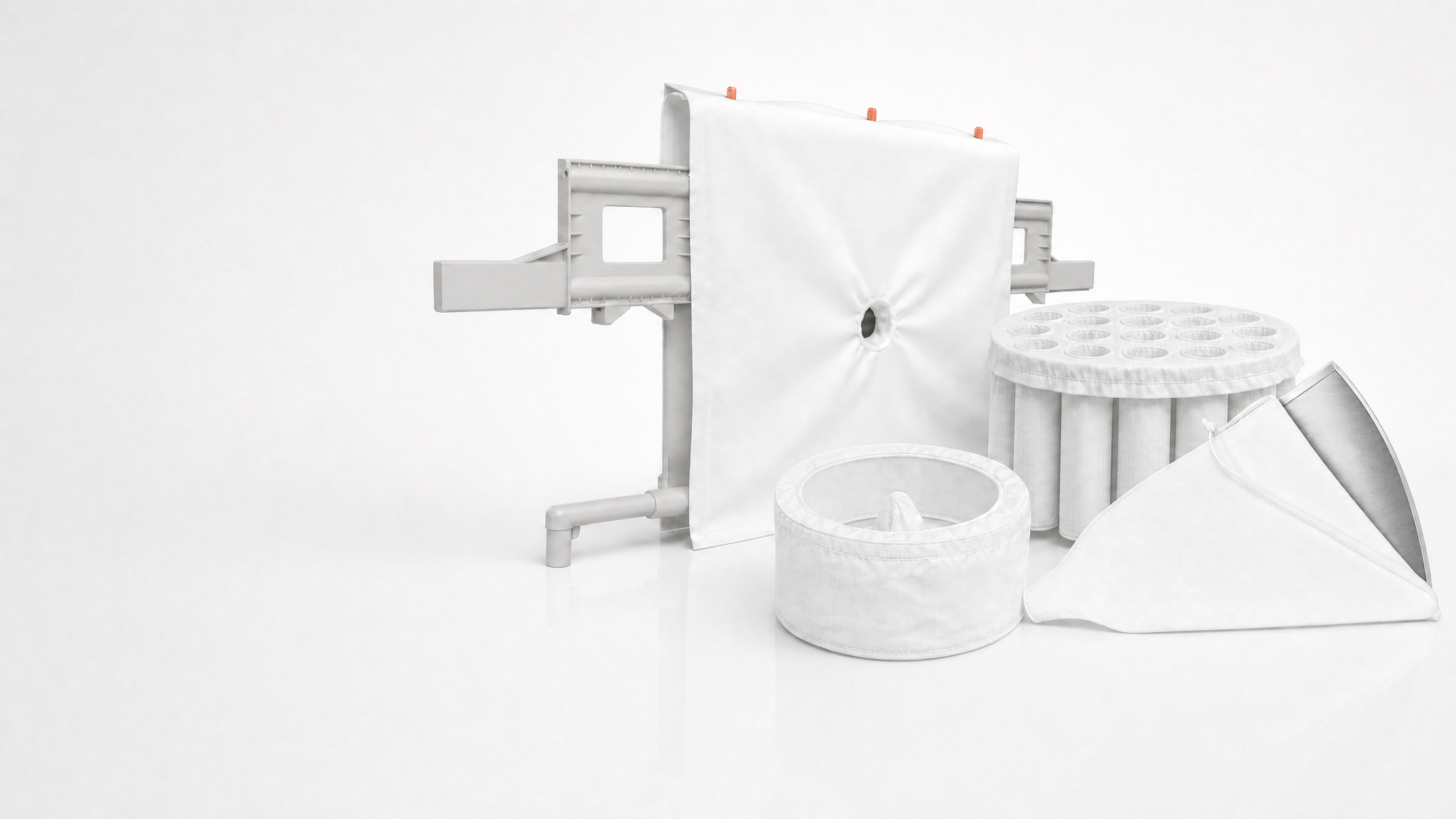
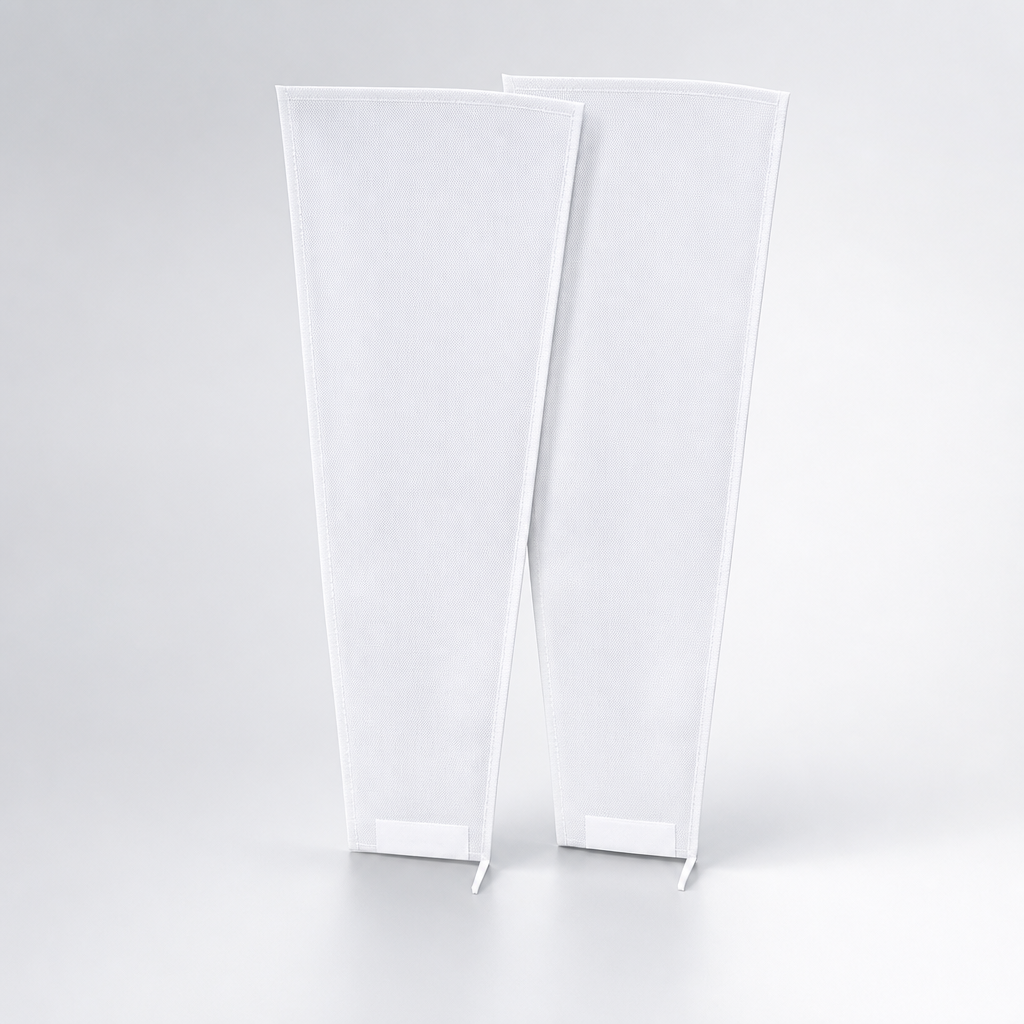
On a rotary disc filter the fabric can be supplied in two very different formats: as a sewn sector bag that is pulled over the whole sector like a cover, or as a precision-cut panel that is fixed to the sector frame with caulking cord, clamping strips or wire. Both work. Which one is right depends on the sector design, on how the plant is serviced and on how much downtime a change-out is allowed to take.
How the fabric works on a disc filter
The discs sit on a horizontal shaft and rotate through a slurry trough. In the submerged phase, vacuum applied through the sector draws liquid through the fabric and a cake builds up on both faces of the disc. As the sector leaves the trough, air continues to be drawn through the cake, which dewaters and dries it. The cake is then discharged and the sector re-enters the slurry. Every revolution therefore combines wet loading, an air-flow phase and a mechanical discharge event – and the fabric has to survive all three, thousands of times.
That cycle explains most fabric failures. Blinding shows up as falling throughput and wetter cake. Abrasion shows up at the discharge edge and wherever the fabric can move against the drainage grid. Poor sealing at the sector edges shows up as fines in the filtrate long before the fabric itself is worn out.
Sector bags
A sector bag is sewn to the shape of the sector and slipped over it. The attraction is speed and repeatability: there is no cord to set, no strip to align, and a bag can be changed by maintenance staff without a specialist. Because the bag encloses the sector, the sealing function is largely built into the sewn geometry rather than into the fitter's technique.
The property that makes or breaks a bag is elasticity. A fabric with a controlled ability to stretch during fitting and then contract onto the sector goes on far more easily and ends up tight over the whole drainage surface. A stiff fabric either will not go on at all or, once on, leaves slack areas that flap, chafe and eventually tear at the same place every time.
Precision-cut panels
Cut panels are the classic route where the sector is built for a cord groove or a clamping arrangement. They allow a wider choice of fabric constructions, including heavier and stiffer weaves that could never be pulled over a sector as a bag, and they are often the only option on older or non-standard frames. The trade-off is fitting time and fitting skill: the seal is created on site, so the result depends on how carefully the cord is seated and how evenly the panel is tensioned.
Installation and fit
- Controlled oversize: a bag or panel that is cut exactly to the nominal sector dimension is usually too small once it is on. The pattern has to allow for the seam allowance and for the way the fabric drapes over the grid.
- Elasticity and shrinkage: a defined stretch-and-recover behaviour is what turns a difficult fit into a routine one, and it is also what keeps the fabric tight after the first wet cycles.
- Seams and hems: seams should sit where the cake does not shear across them, and the open end needs a hem that can take repeated pulling without unravelling.
- Fixing at the hub end: whatever the format, the hub end must be positively secured. This is where bypass most often starts.
- Folds are the enemy: any fold or slack area rubs against the drainage grid under vacuum and becomes a wear hole within weeks.
Can bags be cleaned and reused?
Disc filter fabrics are consumables. Washing – with water, or chemically where the solids justify it – can recover part of the lost permeability and is worth doing when the process allows. But it does not reverse mechanical wear or fibre damage, and a fabric that has already been abraded at the discharge edge will not come back. Planning replacement intervals from actual throughput and cake moisture data is more useful than trying to squeeze the last cycle out of a worn cloth.
Materials
Polypropylene is the robust default for cold, chemically demanding duties: good chemical resistance, hydrolysis-stable, low moisture uptake. Polyester offers higher mechanical and abrasion strength but has to stay inside its chemical limits, in particular in hot alkaline or hot wet conditions. Polyamide is very abrasion-resistant but takes up water. Where temperature or aggressive chemistry go beyond these, PTFE and other special constructions come into play. Which combination fits is decided by the real process data, not by a datasheet comparison.
What we need in order to quote
Disc diameter and number of sectors, the sector drawing or a used sample, the fixing method on the machine (bag, cord groove, clamping strip), slurry composition and solids content, temperature and pH, the target cake moisture and the throughput you need. With that we can propose fabric, format and confection. See our RF-RD Series disc filter bags and sector cloths and the overview of rotary disc filters.
Conclusion
The format is not a detail. A sector bag buys fast, repeatable change-outs and forgives the fitter; a precision-cut panel buys freedom in fabric construction and suits frames built for cord or clamping. In both cases the fabric has to be dimensioned for the sector, not just for the slurry. Tell us about your machine – get in touch.